Outdoor workers are at risk of extreme heat due to physiological strain, dehydration, injury, and loss of productivity, and warning systems can deliver information without diminishing the practical challenges to taking protective action. This protocol compares the effectiveness of forecast-triggered SMS warnings, low-cost cooling support, and a combination of both to decrease heat-related morbidity among urban outdoor workers in Dhaka, Bangladesh. The study will include about 1,080 workers in a four-arm, 2×2 factorial cluster randomized trial that will assign 60 work crews to one of four conditions: usual practice, SMS, cooling support, or combined intervention. The primary endpoint is moderate or severe occupational heat illness occurrence at the season level; secondary endpoints include physiological strain, hydration, work interruption, protective behavior, and productivity. Design stage calculations suggest that the study will have about 87% nominal power to detect a 30% relative reduction at 35% baseline risk with an intracluster correlation of 0.03; a conservative α=0.025 sensitivity for two co-primary factorial main effects results in about 80% power. The study separates informational and resource-enabling mechanisms and offers a solid foundation for assessing scalable integrated heat protection in dense, fast-warming urban environments.
Research ArticleClimate and HealthIn progress
Beyond Heat Alerts: A Cluster-Randomized Trial of SMS Warnings and Cooling Support among Urban Outdoor Workers
Correspondence: safrin2468@gmail.com
Abstract
Keywords occupational heat stressheat-health warning systemsSMScooling interventioncluster randomized trialoutdoor workers
1. Introduction
Extreme heat is no longer just an occasional occupational risk, but a frequent limitation on health and safety and productive work in rapidly warming cities. Outdoor work involves exposure to direct solar radiation, high ambient temperature, humidity, metabolic heat production, and limited recovery periods, and thus involves repeated challenges to thermoregulatory capacity. The risks of dehydration, cardiovascular strain, neurocognitive impairment, heat exhaustion, heat stroke, kidney stress, and injury risk are associated with heat exposure, and many of these risks occur before the worker reaches a clinical emergency threshold (Ebi et al., 2021). The economic impacts are not limited to morbidity; higher temperatures also lead to a decrease in the effective labor force and in the intensity of labor, especially in low- and middle-income countries where manual outdoor work is still economically relevant (Dasgupta et al., 2021).
Global modelling also shows that the losses of heavy labour are increasing with warming, and that working during cooler times provides less protection in the face of increasing early-morning heat (Parsons et al., 2021). Urban warming also exacerbates the inequitable distribution of labor losses, as there are significant differences in exposure, built form, occupation, and access to protective resources between neighborhoods and worker groups (He et al., 2022). While climate mitigation brings benefits in terms of labor productivity, near-term protection of occupations is still required because of the heat already present in the current climate (Zhao et al., 2022).
The problem is reinforced by the occupational studies. Fatigue, loss of concentration, loss of dexterity, dehydration, and changes in risk-taking have been linked to hot work conditions and injuries (Spector et al., 2019), and pooled observational analyses have found a positive association between workplace heat and occupational injury risk (Binazzi et al., 2019). The workers' compensation data also indicate that heat-related illness can occur in a wide variety of occupations and often occurs on days when the heat conditions are not necessarily the most extreme, as often assumed (Hesketh et al., 2020). The challenge is particularly relevant in South Asian megacities where the built environment is dense, summers are hot and humid, the majority of the population is engaged in informal employment, they have limited bargaining power, and are dependent on income.
A recent pilot study in Dhaka revealed a high prevalence of heat-related symptoms among informal workers and identified outdoor work as a high-risk environment (Shahrujjaman et al., 2025). In international field studies, core and skin temperature, heart rate, dehydration markers, and physical work capacity are shown to be measurably increased in outdoor workers and decreased (Ioannou et al., 2022). Climate-related reviews also suggest that the strain on the occupation is likely to increase when there are no multi-level controls, which include environmental, organizational, and individual controls (Habibi et al., 2021).
The goal of heat-health warning systems is to try to intervene before the exposure becomes hazardous by converting forecasts into warnings and recommended actions. Their reasoning is sound: information is received prior to or during a hazardous time, providing hydration, work-rest modification, shade seeking, symptom recognition, or task rescheduling. However, information cannot eliminate response costs. The decision-making context of an outdoor worker who is paid by task and/or restricted by a supervisor is very different from that of a household resident who can stay indoors. Modelling of agricultural work adaptations reveals that rest and cooled recovery not only decrease the heat risk but also have an impact on time, earnings, and labour costs, highlighting the need for awareness and feasible action as two intervention components (Tigchelaar et al., 2020). Field experiments also demonstrate that environmental heat directly impacts worker productivity, including in tropical labor environments where deforestation increases the heat exposure of workers (Masuda et al., 2021). A warning has therefore limited causal reach if the recipient does not have water, shade, recovery time, cooling materials, or permission to act.
Experimental studies: recent research for multi-component occupational heat protection. A cluster-randomized trial of 528 workers in the outdoor power-grid sector in southern China found reduced rates of OHRI with a package of training, protective equipment, monitoring and warnings, and workplace communication (Ding et al., 2025). That trial demonstrated the feasibility of cluster allocation and operational heat-risk messaging in a working population, but the trial's bundled design obscures the marginal contribution of heat-risk messaging from the practical resources that enable protective action to be taken. This difference is key for urban employers and public agencies to consider when determining if low-cost SMS alerts are enough or if material cooling support is needed.
The present study thus suggests a four-arm 2x2 cluster randomized trial with outdoor work crews in urban settings in Dhaka. The objective is to quantify the individual and combined impacts of SMS warnings and low-cost cooling assistance on occupational heat illness and associated physiological, behavioral, and productivity outcomes when the warnings are triggered. The goals are to measure the main effect of SMS, measure the main effect of cooling support, determine whether the package is superior to either SMS or cooling support alone, explore behavioral and physiological pathways, and determine if there are differences in the package by occupation and heat intensity. The main hypotheses are that both SMS and cooling support will decrease the incidence of moderate or severe heat illness at the season level, and the greatest decrease will occur under the combined package. The study provides a causal test of the relationship between heat alerts and health protection, as it separates information from response capacity by providing workers with feasible means to respond. The cluster structure is based on actual work organization, minimizes cross-arm spillover, and facilitates policy interpretation at the crew, contractor, and municipal program levels. This framework also differentiates between the reach of communication and its feasibility of response, between implementation failure and lack of a protective intervention effect.
2. Literature Review
2.1 Occupational heat exposure, strain, and vulnerability
Outdoor occupational heat is a complex exposure and not a direct result of air temperature. The heat load a worker has to dissipate depends on direct solar radiation, humidity, metabolic workload, clothing, task duration, and limited recovery. This is important because the adverse outcomes range from discomfort, decreased work capacity, dehydration, heat exhaustion, injury, to medical emergency. There is a consistent relationship between environmental heat and occupational injury in the literature, and plausible mechanisms linking environmental heat to occupational injury include fatigue, slower reaction time, impaired attention, dehydration, and reduced dexterity (Binazzi et al., 2019; Spector et al., 2019). Administrative compensation data also indicate that heat illness is not limited to extreme temperatures, but is spread across a variety of manual occupations (Hesketh et al., 2020). The same conclusion can be drawn from physiological field data: outdoor workers who are exposed to heat have higher core and skin temperatures, higher cardiovascular strain, dehydration, and measurable decreases in physical work capacity (Ioannou et al., 2022). This literature provides support for a trial endpoint structure that includes clinically meaningful heat illness and physiological and functional changes that occur prior to emergency-level events.
This burden is expected to be compounded in the densely populated cities in South Asia, where humid heat, radiant load from built surfaces, exposure to traffic, long hours of outdoor work, and limited recovery space are coupled with informal or subcontracted work. The prevalence of heat-related symptoms among informal workers is still not well documented in Dhaka, but a recent pilot study revealed a high prevalence of heat-related symptoms among informal workers and outdoor work as a particularly exposed environment (Shahrujjaman et al., 2025). Occupational reviews for climate change also indicate that heat strain will increase with warming if there are no environmental, organizational, and individual controls in place (Habibi et al., 2021). Most importantly, the same ambient conditions do not produce the same internal strain – workload, acclimatization, hydration opportunity, clothing, baseline vulnerability, and shift timing change the worker-level dose. Therefore, a trial based on only citywide forecast temperature would be susceptible to exposure misclassification. The present protocol thus considers site-level wet-bulb globe temperature (WBGT), task observations, and worker-level physiological measures to be complementary measures of occupational heat stress, not interchangeable.
2.2 Behavioral feasibility and work-organizational constraints
Many occupational heat instructions are expressed with a focus on personal behaviors: drink water, rest, get in the shade, decrease exertion, and report symptoms early. These are biologically appropriate but may be structurally challenging to perform while working manually for pay. Occupational adaptation reviews focus on multi-layered controls, such as scheduling, workload management, hydration, shaded recovery, and workplace governance, in addition to worker knowledge (Habibi et al., 2021). Modelling studies also indicate that rest and cooled recovery have the potential to reduce heat risk, and that it can also generate time, income and labour cost impacts (Tigchelaar et al., 2020). Awareness and feasible action are two different mechanisms, which implies their inclusion in the design of intervention. It is possible for a worker to grasp the warning but not be able to act in response because breaks are not paid, there is no shade, water is far away, or the supervisor places more emphasis on production. This is particularly true for piece-rate, daily wage, subcontracted labor, and delivery jobs, where the opportunity cost of the stop is immediate.
Field interventions are increasingly moving heat protection from individual to crew/organization at the employer level. An agricultural intervention based on participatory education and decision support for landowners/supervisors showed that it is possible to implement a group-level intervention and to repeat physiological monitoring under operational conditions (Chavez Santos et al., 2022). Research among sugarcane workers shows that the intensity of the work, rest, shade, and water intake are all additive factors that contribute to thermal strain, not individual factors that are provided (Lucas et al., 2023). Multi-season intervention programs that boost rest, shade, hydration, hygiene, implementation monitoring, and organizational involvement have also been found to improve kidney-injury and inflammatory outcomes (Hansson et al., 2025). The rationale for cluster randomization is reinforced by these studies, which bring together many protective resources, including supervisors and work routines. Meanwhile, bundled interventions introduce an attribution problem: If interventions are implemented in communication, training, equipment, or work organization, the marginal effect of the different components cannot be determined. That’s the reason for the factorial design of the current trial.
2.3 Cooling support, physiological strain, and work capacity
Cooling support includes a wide range of different controls such as access to water, shaded recovery, wet towels, fans, and body cooling, as well as more advanced wearable devices. Combinations that minimize heat storage, and places the least burden, and do not hinder the efficiency of task performance are most strongly supported by available practical evidence. In the industrial context, a cooling oasis onsite with a combination of hydration, cold towels, fans, and water dousing reduced core temperature and heart rate compared to normal working conditions in a Thai industrial setting (Bach et al., 2024). Simulated work in Bangladesh also indicates that combinations of interventions that can be scalable (ventilation, hydration, and environmental cooling) have the potential to decrease heat strain, depending on the type of intervention and on individual worker factors (Smallcombe et al., 2025). In practical reviews, the focus is on the importance of the heat-transfer capacity and mobility, clothing, climate, maintenance, and compatibility with the work process for real-world effectiveness (Foster et al., 2020). The findings reflect and support a low-cost package with emphasis on access and usability, not on a technology.
Evidence for personal cooling devices is not as consistent. Cooling bandanas and vests were pilot tested on agricultural workers with inconsistent results—small populations were used, and cooling equipment could not be worn while performing heavy work (Morrissey-Basler et al., 2024). In contrast, simulated occupational studies demonstrate greater thermoregulatory benefit in the presence of all three factors: fluid access, shade, and body cooling (Hansson et al., 2024). The productivity literature is also important since employers might be reluctant to accept the heat controls if they believe that protection will result in a decrease in productivity. A piece-paid agricultural workers' productivity program of rest-shade-hydration did yield productivity patterns that were consistent with the maintenance of output with greater protection (Hansson et al., 2024). Cooling support is therefore best viewed as 'action enablement' - what workers can physically and organizationally do as a result of the heat. The other question is whether this support actually has an impact on illness and if so, whether this impact is enhanced when the workers are provided with timely, specific information about risks.
2.4 Heat warnings, risk communication, and the factorial evidence gap
The way heat-health warning systems work is different. They are able to take meteorological information and make it a 'time-dependent cue' which will hopefully influence behaviour before risk is serious. Forecast accuracy is not the only factor that determines their effectiveness – the selection of the threshold, the timing of the warning, who the audience is, how credible the message is, how well the audience understands the message, how relevant the message is locally and how feasible a response is – all affect whether the warning will influence action.
There have been considerable differences between how well heat action plans are implemented and how well warnings are linked to local action measures (Kotharkar & Ghosh, 2022). Later syntheses call for local thresholds, ones linked to the context of exposure and health risk, rather than uniform thresholds based on temperature (Chandra N & Lee, 2025), and for user- and context-driven, smarter systems with actionable guidance (Li et al., 2022). This is illustrated by operational examples. A co-designed system in subtropical Taipei involved using WBGT, evidence of health outcomes, and stakeholder preferences to decide on the design of triggers and forecast frequency (Lung et al., 2023) While recent research on threshold development in Canada revealed that seasonality and changing trigger values could have a significant impact on trigger design (Issa et al., 2021).
The theory of risk communication can be used to understand that a technically correct warning may not have the health impact that is expected. Warning receipt is linked to threat appraisal, response appraisal, trust, and protective action in the context of heat-adapted applications of the Protective Action Decision Model (Heidenreich & Thieken, 2024), and communication research focuses on concise, specific, locally relevant instructions, in channels that vulnerable groups use (VanderMolen et al., 2022).
Heat risk has also been found to be mediated by prior experiences, socioeconomic factors, location, and perceived vulnerability, in perception studies [30]. Most warning system studies, however, focus either on population-level warnings, warning system design, perceptions, or intended actions, rather than on actual health effects of active exposure to the warning system among workers. The recent TEMP cluster randomized trial was conducted to determine whether a multifaceted package could reduce occupational heat-related illness; the fact that these components are all packaged together makes it difficult to separate the information component from the resources that enable action to be taken (Ding et al., 2025). Thus, the main drawback in the literature that was consulted here is not the ability of heat protection to be effective, but what the minimum elements are. The gap is directly tested in a 2×2 cluster trial, where the SMS effect is estimated independent of the cooling-support effect and the combined SMS + cooling-support effect is estimated separately from the SMS and cooling-support effects.
3. Conceptual or Theoretical Framework
An integrated Protective Action Decision Model–action enablement is used to guide the trial. The communication part is inspired by the Protective Action Decision Model (Heidenreich & Thieken, 2024), in which the perception of a hazard has an influence on the threat appraisal process, the appraisal process of protective responses, and, subsequently, behavior. Risk communication is not considered a standalone intervention. The success of the message is determined by reach, message specificity, timing, and actionability; and the communication research with heat-vulnerable populations focuses on clear, locally relevant instructions that are communicated via trusted channels (VanderMolen et al., 2022). The perception of heat stress is also place-, socioeconomic-, experience-, and vulnerability-dependent, meaning that a warning has the same impact in varying situations (Hass et al., 2021).
The second one is action enablement. Cooling resources modify the opportunity set that influences a worker's choice to take protection measures by reducing the time, material, and physiological costs of taking protection measures. When a warning becomes something that can be done, the presence of accessible water, shade, cooling towels, recovery space and scheduled micro-breaks can make all the difference. Practical cooling research is focused on compatibility with work routines and low-resource environments (Foster et al., 2020), and work-capacity modelling seeks to relate environmental heat directly to the loss of physical work capacity as a function of a wide range of environmental heat (Foster et al., 2021). In the framework, information is thus differentiated from capability.
The proposed causal sequence is shown in Figure 1, which has an information pathway and a resource-enablement pathway that both lead to the physiological response and protective behavior.
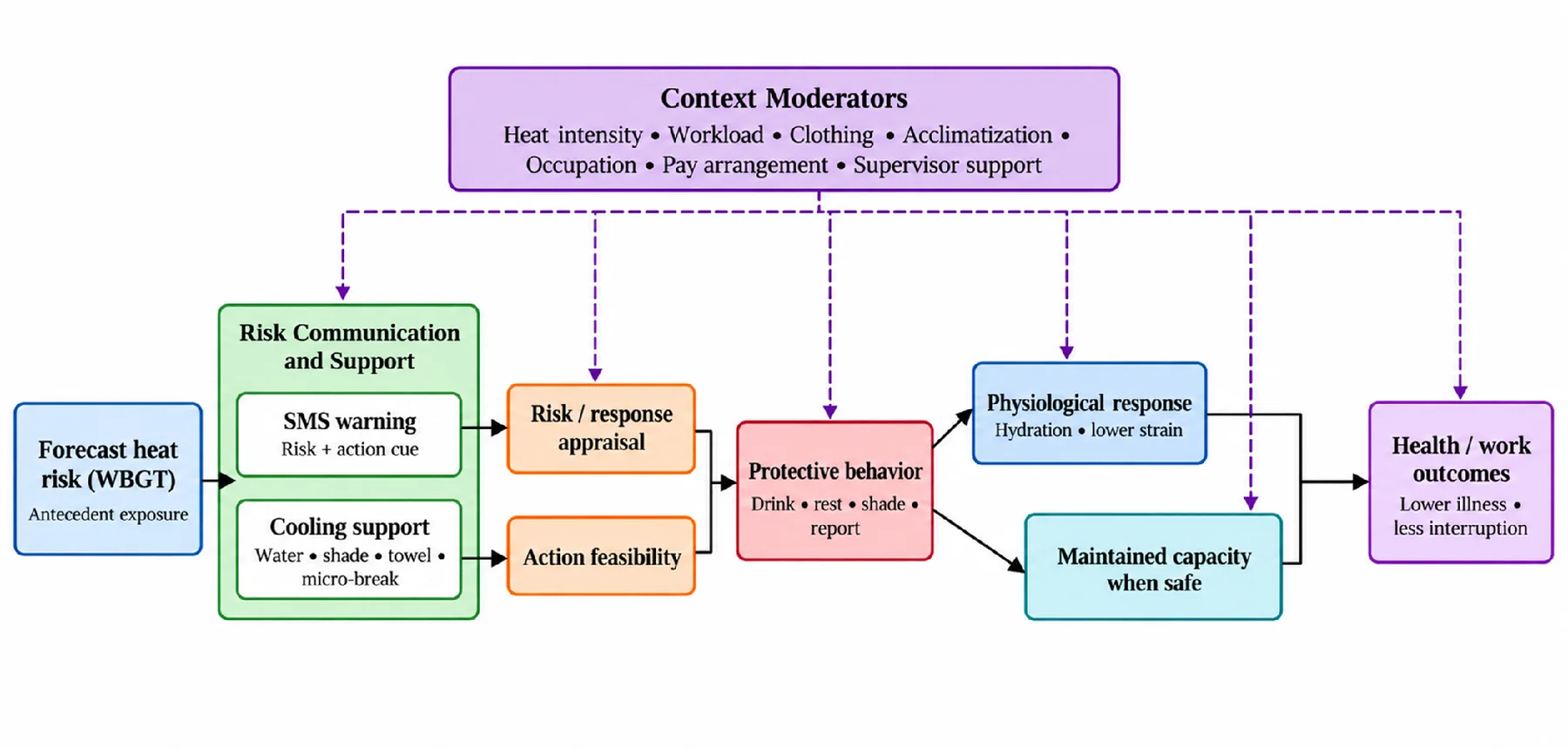
The figure depicts the forecast heat risk as a catalyst for SMS-mediated risk recognition, action knowledge, and protective intention, which include greater access to hydration, shade, and recovery, and reduction of response costs. Both routes lead to the intermediate variables of timely drinking, timely rest, timely shade use, and timely symptom reporting, or lack thereof. These behaviours impact physiological strain and dehydration, which in turn impact heat-illness risk, work interruption, and productivity. The joint arm is supposed to have the greatest impact because information can be used to determine when and how to act, and cooling can increase the space of allowable actions.
Moderators that are specific to the context are: wet-bulb globe temperature, presence of others, metabolic workload, clothing, sex, age, acclimatization, baseline health vulnerability, pay arrangement, supervisor support. Randomization will uncover intervention effects, and repeated exposure and process measurement will help determine if differences are associated with increased message uptake, use of resources, behavior change, and/or reduced physiological strain. In prespecified pathway analyses, therefore, there will be a distinction between intervention delivery, appraisal, behavior, physiological response, and illness. The formal mediation will be exploratory, as mediator-outcome relationships are post-randomization and will have to be supplemented by further causal assumptions. Moderation analyses will be used to determine under what circumstances each intervention pathway either weakens or strengthens, and can be used in conjunction with fidelity and mechanism analyses, instead of as a reflection of overall failure.
4. Methodology
4.1 Trial design, setting, and estimands
A pragmatic, four-arm, 2×2 factorial cluster-randomized controlled trial is planned for the hot season in Dhaka, Bangladesh. Stable work crews or worksite teams are the unit of randomization because workers within a crew share supervisors, schedules, recovery locations, and protective resources; individual randomization would therefore create substantial contamination. The two factors are forecast-triggered SMS warnings (present/absent) and cooling support (present/absent), producing four conditions: usual practice, SMS only, cooling only, and SMS plus cooling support. Sixty clusters will be allocated equally, with 15 clusters per arm. The two factorial main effects are the co-primary causal estimands: (1) the average effect of assignment to SMS across cooling conditions and (2) the average effect of assignment to cooling support across SMS conditions. The SMS cooling interaction and the combined-versus-usual-practice contrast are prespecified secondary estimands because the study is not primarily powered for interaction detection. Baseline enrollment and measurement will be completed before allocation is released. This design preserves real work organization while allowing the informational mechanism and the resource-enablement mechanism to be estimated separately.
Table 1. Study objectives, hypotheses, estimands, and outcome domains.
| Objective | Hypothesis/question | Primary estimand | Main measures |
|---|---|---|---|
| Estimate SMS effect | Forecast-triggered SMS reduces season-level heat illness relative to no SMS. | Factorial SMS risk ratio and risk difference | Primary heat-illness endpoint; SMS delivery, recall, and protective actions |
| Estimate cooling effect | Cooling support reduces season-level heat illness relative to no cooling. | Factorial cooling risk ratio and risk difference | Primary endpoint; hydration, rest, shade, cooling-resource use |
| Assess joint package | The combined condition is expected to produce the lowest risk; interaction is secondary and will be assessed on multiplicative and absolute-risk scales. | SMS × cooling interaction; standardized combined-versus-usual-practice contrast | Primary endpoint plus physiological and work outcomes |
| Assess mechanisms | Protective behavior and reduced physiological strain link intervention exposure to health outcomes. | Mediator-specific pathway estimates | Message uptake; water/rest/shade use; heart rate; hydration; body-mass change |
| Assess heterogeneity | Intervention effects differ across work and heat contexts. | Prespecified subgroup interaction contrasts | Occupation; WBGT; sex; baseline vulnerability; pay arrangement |
Table 1 aligns each causal question with its estimand and measurement domain. The interaction is interpreted as a secondary question on both multiplicative and absolute-risk scales rather than as a prerequisite for estimating the two main effects. Figure 2 presents the sequence from cluster recruitment and individual enrollment to factorial intention-to-treat analysis.
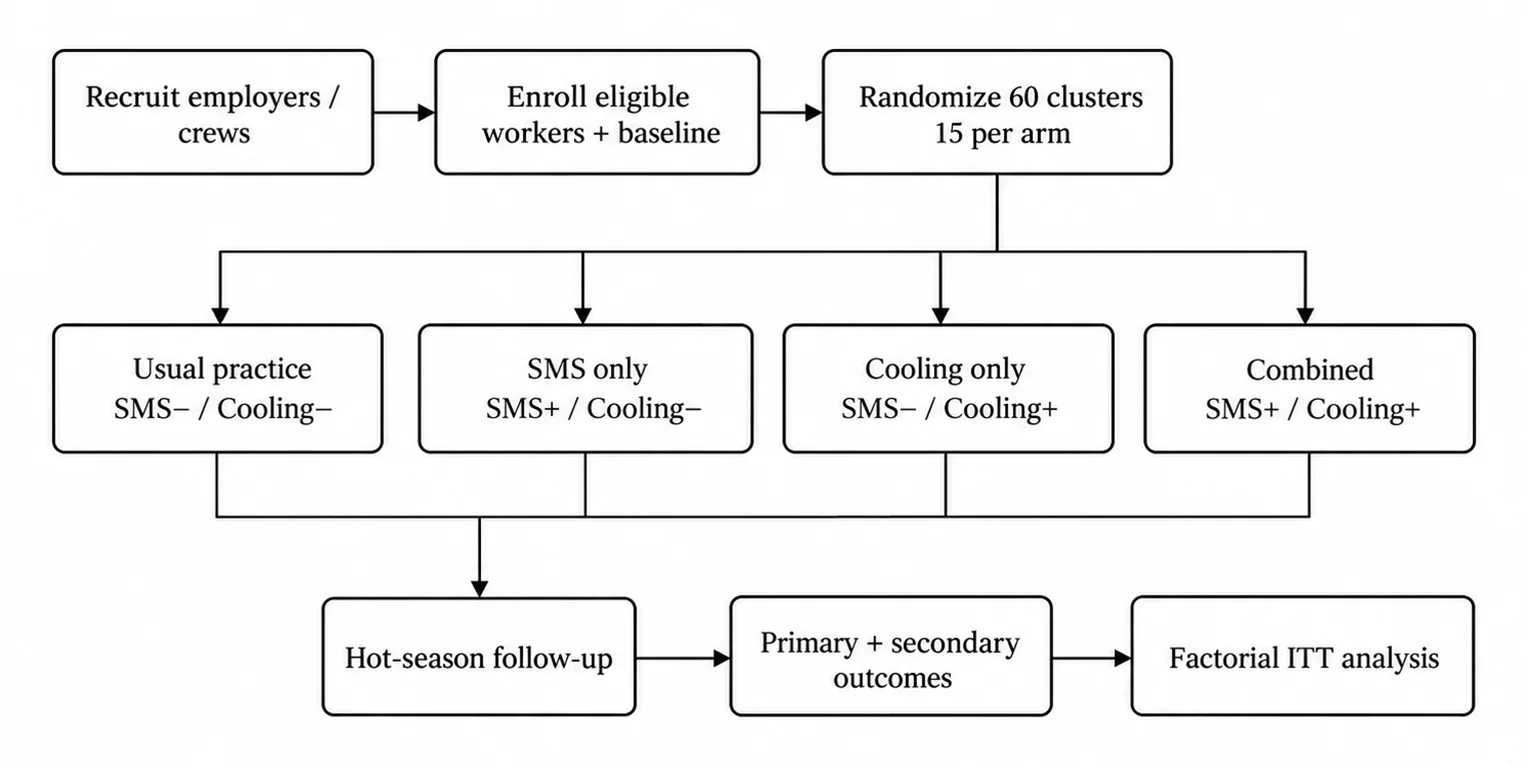
The sequence separates baseline enrollment from allocation and maintains assigned factor exposure throughout follow-up. This ordering reduces allocation-related selection, preserves the cluster as the operational unit of delivery, and makes the 30-versus-30 cluster factorial main-effect contrasts explicit.
4.2 Population, cluster definition, eligibility, and recruitment
Eligible participants are adults aged at least 18 years who perform outdoor manual work for at least four hours per shift and are expected to remain in the same crew during the follow-up period. Recruitment will target sanitation, road maintenance, construction, utility, delivery-logistics, and comparable occupations with stable supervisory units. A cluster is defined as a group of workers who share a routine supervisor or foreperson, work schedule, and access to the same rest/cooling resources; workers who routinely rotate across two candidate clusters will be assigned to a single operational cluster before randomization or excluded when separation is not feasible. Workers requiring immediate medical restriction from hot work at screening will be referred for clinical assessment and excluded from exposure monitoring. Recruitment will proceed in stages: employers or contracting units, eligible crews, and then individual workers. Written consent and baseline assessment will occur before randomization. The target is 60 clusters with a mean of 18 participants (approximately 1,080 workers). Recruitment will aim to limit extreme cluster-size imbalance, and restricted allocation will balance occupation sector and prespecified cluster-size bands. Participants who leave employment after randomization will not be replaced for the primary season-level analysis; their observed data will be retained under the intention-to-treat principle.
4.3 Intervention conditions and heat-trigger algorithm
The SMS intervention will deliver brief Bangla messages when a prespecified forecast heat-risk algorithm is triggered. Before recruitment, the trigger rule will be locked using locally relevant forecast WBGT categories, pilot exposure information, and operational feasibility; the same algorithm will be applied to every cluster so that only message assignment differs by a randomized factor. Trigger-day messages will be sent before the shift and will identify the expected hazard level, specify hydration, rest, shade, workload, and symptom-response actions, and state when urgent assistance is required. A single mid-shift reinforcement will be permitted under the highest protocol-defined risk category. The cooling-support factor will provide chilled potable water, shaded or mobile recovery space, reusable cooling towels, and protected micro-break access scaled to protocol-defined heat intensity. Oral rehydration solution will be used only under prespecified indications rather than as routine replacement for water. The combined arm receives both components in full; the usual-practice arm receives no study SMS and no study-provided cooling package, although existing workplace practices are not withdrawn.
Table 2. Factorial intervention conditions and component exposure.
| Trial arm | SMS factor | Cooling factor | Operational components |
|---|---|---|---|
| Usual practice | Absent | Absent | Existing workplace practice without study SMS or study cooling package |
| SMS only | Present | Absent | Bangla forecast-triggered risk message; hydration/rest/shade instructions; symptom escalation guidance |
| Cooling only | Absent | Present | Chilled potable water; protocol-indicated oral rehydration; shaded/mobile recovery; reusable cooling towels; protected micro-break access |
| Combined | Present | Present | Full SMS warning component plus full cooling-support component |
The factorial structure isolates communication from material support while retaining a combined package that is policy-relevant. Fidelity will be measured rather than assumed. Time-stamped logs will capture successful SMS delivery, message recall in sampled checks, water and shade availability, cooling-towel availability, actual break access, supervisor implementation, stock-outs, equipment failure, and cross-arm sharing. These measures will be summarized by randomized arm before any per-protocol or mechanism analysis is attempted.
4.4 Exposure, outcomes, and measurement schedule
Site-level wet-bulb globe temperature will be recorded across monitored work shifts using calibrated instruments positioned to represent the crew's actual work environment. Measurements will be time-synchronized with air temperature, relative humidity, solar/radiant conditions where available, and task observations so that environmental exposure can be linked to workload and outcome timing. Baseline assessment will record age, sex, occupation, work intensity, clothing, acclimatization, pay arrangement, previous heat illness, relevant medication categories, baseline vulnerability, and supervisor support. During follow-up, brief shift-level records will capture heat symptoms, water intake, rest and shade use, cooling-resource use, work interruption, absenteeism, and task output where an objective or supervisor-verified metric is comparable across workers. A monitored subsample will undergo pre/post-shift body mass assessment, urine specific gravity, and heart-rate monitoring using standardized measurement windows.
The primary endpoint is a worker-level binary indicator of at least one protocol-defined moderate or severe occupational heat-illness episode during the season. An episode will require a prespecified compatible symptom pattern occurring during or shortly after a monitored work shift together with functional impairment or clinical action, such as cessation of work, assisted cooling/first aid, or referral. Severe episodes include prespecified danger signs such as syncope, altered mental status, suspected heat stroke, or emergency referral and will undergo allocation-masked adjudication. The detailed symptom algorithm, timing window, and adjudication rules will be locked before enrollment. Secondary outcomes include end-shift physiological strain, hydration indicators, symptom burden, work interruption, absenteeism, protective behavior, SMS recall, resource use, and productivity. Outcome definitions and measurement windows will be identical across arms, and all safety events will be recorded regardless of protocol adherence.
4.5 Randomization, allocation concealment, masking, and contamination
An independent statistician who is not involved in recruitment will generate the restricted randomization sequence within occupation strata, with additional balance constraints on prespecified cluster-size bands and 15 clusters per arm. Allocation will remain concealed from recruiters and baseline assessors until cluster enrollment is closed and baseline data are complete. Participants, supervisors, and intervention field teams cannot be masked to SMS receipt or visible cooling resources. In contrast, adjudicators of severe heat illness and the primary analysis dataset will use masked arm codes until the primary model specification is finalized. Identical outcome instruments, fixed measurement windows, standardized field contact, and prespecified decision rules will reduce differential ascertainment. Contamination will be measured through reports of message forwarding, workers moving between crews, and sharing of study cooling resources; contamination will not alter the intention-to-treat analysis but will inform sensitivity and implementation analyses.
4.6 Sample size and design-stage operating characteristics
The planned enrollment is 1,080 workers in 60 clusters (mean cluster size 18). For each factorial main effect, the design compares 30 clusters assigned to the component with 30 clusters not assigned to it. The central planning scenario assumes a 35% season-level primary-event risk without the component, a target relative risk of 0.70, intracluster correlation (ICC) of 0.03, and two-sided nominal α=0.05. The corresponding design-effect approximation is 1+(18−1)×0.03=1.51, giving an approximate effective sample of 1,080/1.51≈715 independent observations for a simple two-proportion planning calculation. Under these assumptions, nominal power is approximately 86.9%. Because SMS and cooling are co-primary main-effect hypotheses, the statistical analysis plan will use a Holm procedure to control the family-wise two-sided α at 0.05; a conservative α=0.025 planning sensitivity gives approximately 80% power for the same target effect. The interaction is considered secondary and is expected to be less precise.
The design-stage analyses in Section 5 therefore report nominal operating characteristics over plausible cluster counts, intervention effect sizes, baseline event risks, ICC values, and retention scenarios. These calculations are deliberately labelled as planning outputs rather than participant results. Before the statistical analysis plan is locked, the approximation will be checked by simulation under the final randomization restrictions, anticipated cluster-size variation, attrition, and plausible interaction scenarios. The simulation check will be used to confirm robustness of the planned design rather than to select assumptions after outcome data are observed.
4.7 Statistical analysis
All primary analyses will follow randomized assignment (intention to treat). The season-level binary primary endpoint will be analyzed with a population-averaged log-link model that includes indicators for SMS, cooling support, and their interaction, together with the randomization strata. A modified-Poisson generalized estimating equation with crew-level clustering, robust variance, and a finite-cluster correction will be the default approach because it directly estimates relative risks and is more stable than a log-binomial model when convergence is difficult. Marginal standardized risks will also be reported so that absolute risk differences and numbers needed to treat can be derived with 95% confidence intervals. The two factorial main effects are co-primary and will be evaluated with Holm multiplicity control; the interaction and combined-versus-usual-practice contrast are secondary and will be interpreted primarily through effect size and confidence intervals rather than a binary significance threshold.
Repeated continuous outcomes such as heart rate or body-mass change will be analyzed with mixed-effects or generalized estimating models that account for measurements nested within workers and workers nested within crews. Count outcomes will use Poisson or negative-binomial models as dictated by dispersion. Prespecified effect-modification analyses will examine occupation, sex, baseline vulnerability, pay arrangement, and heat intensity by adding treatment-by-subgroup interactions; these analyses are secondary. Realized WBGT and workload will be used for exposure-response description and prespecified precision/effect-modification analyses rather than as necessary covariates for identification of the randomized primary effect. Missing outcomes and covariates will be described by arm and mechanism; multiple imputation will be used when assumptions are defensible, with complete-case, cluster-level summary, and randomization-based analyses as sensitivity checks. Per-protocol analyses will be secondary and based on prespecified fidelity definitions. Mediation analyses of message uptake, protective behavior, and physiological response will be exploratory and will explicitly state the additional causal assumptions required for post-randomization mediators.
4.8 Ethics, safety, fidelity, and data governance
Written informed consent will precede participation. Identifiers, phone numbers, health measures, and work records will be stored separately under coded study IDs with role-based access. Employers will not receive individual health data, symptom reports, or message-response records. A field safety algorithm will override randomized assignment whenever danger signs are observed and will require immediate cessation of hot work, active cooling, clinical referral, or emergency transfer as appropriate. An independent safety monitor will review serious adverse events and major protocol deviations. Daily field logs will timestamp intervention delivery, WBGT exposure, resource availability, protocol deviations, safety actions, and observation windows. Trial registration, ethics approval, the finalized intervention manual, and a dated statistical analysis plan will precede outcome analysis. De-identified analysis code and a data dictionary will be archived publicly where ethically and contractually permissible. A prespecified stopping rule will govern unexpected serious intervention-related harm, while routine protective actions required for clinical safety will never be withheld for research purposes.
5. Design-stage Operating-Characteristic Results
5.1 Planned operating point and cluster requirement
The first design-stage question is whether the proposed cluster structure is sufficient for a policy-relevant factorial main effect. The central operating point uses 60 clusters, 18 workers per cluster, a 35% control risk, ICC=0.03, and a two-sided nominal α=0.05. Because each factorial component is present in 30 clusters and absent in 30 clusters, the planning contrast uses all randomized clusters rather than only a single pair of trial arms. Table 3 summarizes the fixed assumptions and distinguishes nominal power from the conservative multiplicity sensitivity used for the two co-primary main effects.
Table 3. Central design assumptions for the primary factorial contrast.
| Parameter | Planning value | Analytical role |
|---|---|---|
| Clusters | 60 total; 15 per arm | Provides 30 clusters exposed and 30 unexposed to each factorial component |
| Mean cluster size | 18 workers | Produces nominal enrollment of approximately 1,080 workers |
| Control event risk | 35% | Season-level moderate/severe occupational heat illness |
| Intracluster correlation | 0.03 | Central clustering assumption |
| Target main-effect relative risk | 0.70 | Represents a 30% relative reduction |
| Nominal type-I errors | 5%, two-sided | Nominal per-factor operating-characteristic curves |
| Design effect | 1.51 | 1 + (18 − 1) × 0.03; planning approximation |
| Approximate effective sample | 715 | Nominal enrollment divided by design effect |
| Multiplicity sensitivity | α = 0.025 per factor (conservative) | ≈80% power at RR = 0.70; Holm procedure planned for co-primary tests |
The design effect under ICC=0.03 is 1.51, reducing 1,080 enrolled workers to an approximate effective sample of 715 independent observations for simple planning purposes. Under RR=0.70, nominal two-sided α=0.05 power is approximately 86.9%. Using α=0.025 as a conservative multiplicity sensitivity gives approximately 80.0% power. Figure 3 shows the nominal cluster-count gradient for three effect magnitudes; these curves are design approximations and not substitutes for the final simulation check described in Section 4.6.
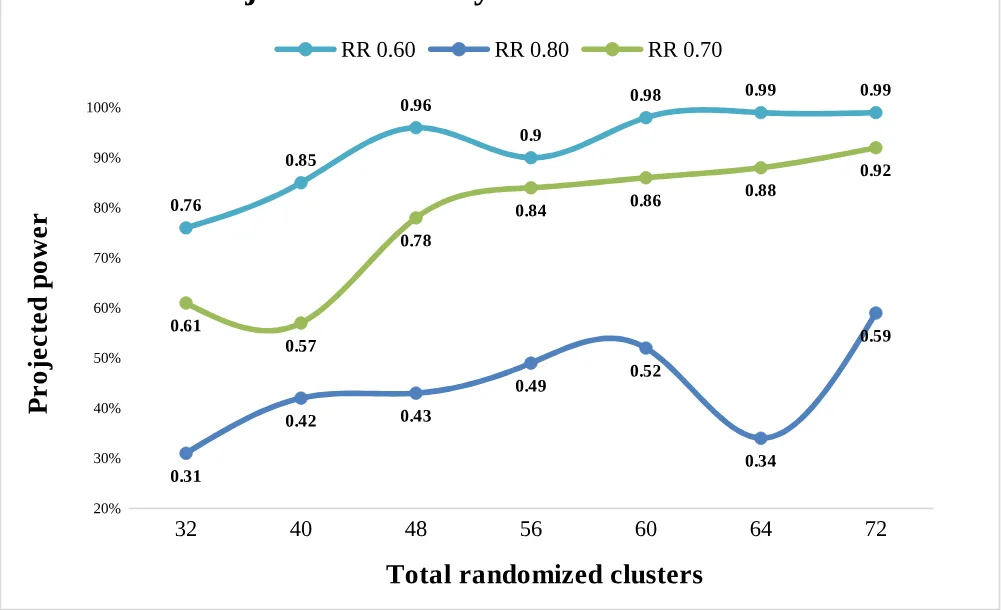
Power rises nonlinearly with cluster count. A 40% relative reduction is identifiable with high power even below 48 clusters, whereas a 20% reduction remains difficult to distinguish at the proposed sample. The planned 60-cluster design therefore targets moderate rather than small intervention effects. Equal allocation of 15 clusters per arm preserves the factorial contrast while retaining interpretable arm-specific estimates. Direct comparisons between the combined arm and usual practice use fewer clusters than each main-effect contrast and therefore carry less precision. Those comparisons remain clinically informative, but the protocol prioritizes the two factorial main effects because they use all randomized clusters and answer the central implementation question: whether communication and material support each contribute independently to protection.
5.2 Sensitivity to intervention effect magnitude
The second design-stage question concerns sensitivity to the true intervention effect. Table 4 reports nominal α=0.05 power at the planned 60 clusters while holding baseline risk and ICC fixed. These values are useful for showing the design's operating range; multiplicity-controlled inference for the two co-primary main effects will follow the procedure specified in Section 4.7.
Table 4. Projected power by factorial main-effect magnitude at 60 clusters.
| Relative risk | Relative reduction | Projected power |
|---|---|---|
| 0.85 | 15% | 32.4% |
| 0.80 | 20% | 52.3% |
| 0.75 | 25% | 72.1% |
| 0.70 | 30% | 86.9% |
| 0.65 | 35% | 95.3% |
| 0.60 | 40% | 98.7% |
Power is 32.4% for a 15% reduction, 52.3% for a 20% reduction, and 72.1% for a 25% reduction. It reaches 86.9% at a 30% reduction and exceeds 95% at a 35% reduction. These values define the inferential boundary of the trial: modest benefits remain scientifically relevant but would produce wider uncertainty and a greater chance of a statistically inconclusive primary test.
5.3 Intracluster correlation and design efficiency
Cluster correlation determines how much information is lost because workers in the same crew share heat exposure, supervisors, work practices, and resources. Table 5 presents the central sensitivity analysis for intracluster correlations from 0.01 to 0.08 at 60 clusters and a relative risk of 0.70.
Table 5. Sensitivity of primary power to intracluster correlation at 60 clusters.
| Intracluster correlation | Projected power at RR = 0.70 | Position relative to 80% planning threshold |
|---|---|---|
| 0.01 | 93.8% | Above |
| 0.02 | 90.5% | Above |
| 0.03 | 86.9% | Above |
| 0.04 | 83.2% | Above |
| 0.05 | 79.5% | Below |
| 0.06 | 76.0% | Below |
| 0.08 | 69.3% | Below |
At an intracluster correlation of 0.01, projected power is 93.8%; at 0.03 it is 86.9%; at 0.05 it falls to 79.5%; and at 0.08 it falls to 69.3%. Figure 4 extends this relationship by comparing 48, 60, and 72 clusters across the same correlation range.
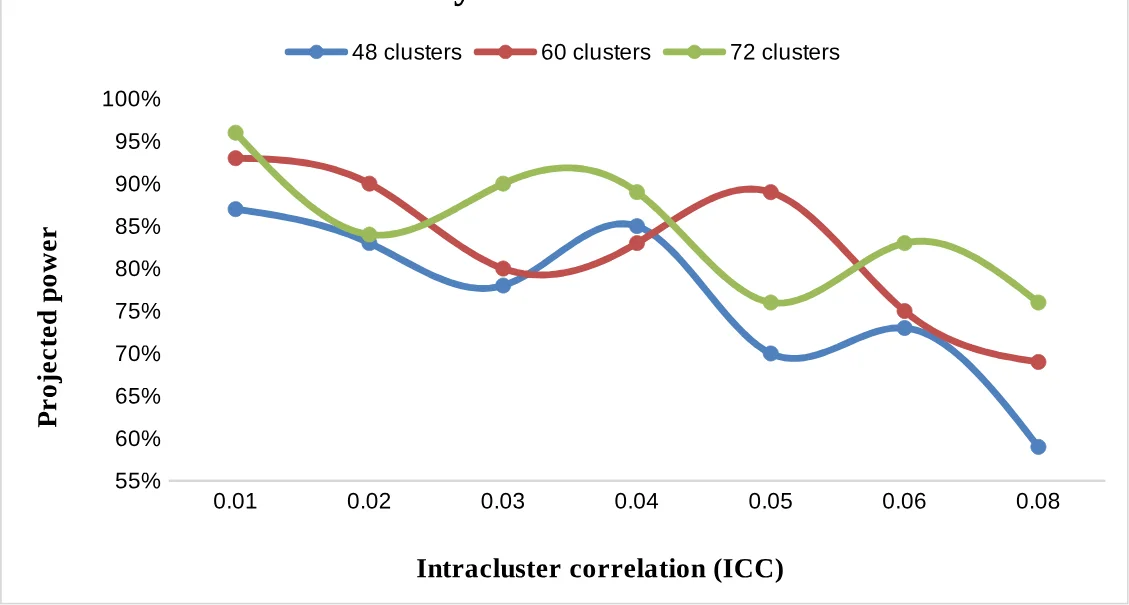
The curves show that adding clusters offsets correlation more effectively than adding workers within already-large clusters. This pattern supports recruitment of many moderate-sized crews rather than a smaller number of very large worksites.
5.4 Detectable effects across plausible baseline risks
Primary-event frequency also controls precision. A rarer endpoint produces fewer informative events, while a common endpoint provides greater power for the same relative contrast. Figure 5 presents the minimum relative reduction associated with approximately 80% power at 60 clusters, 18 workers per cluster, and intracluster correlation of 0.03 across baseline risks from 20% to 50%.
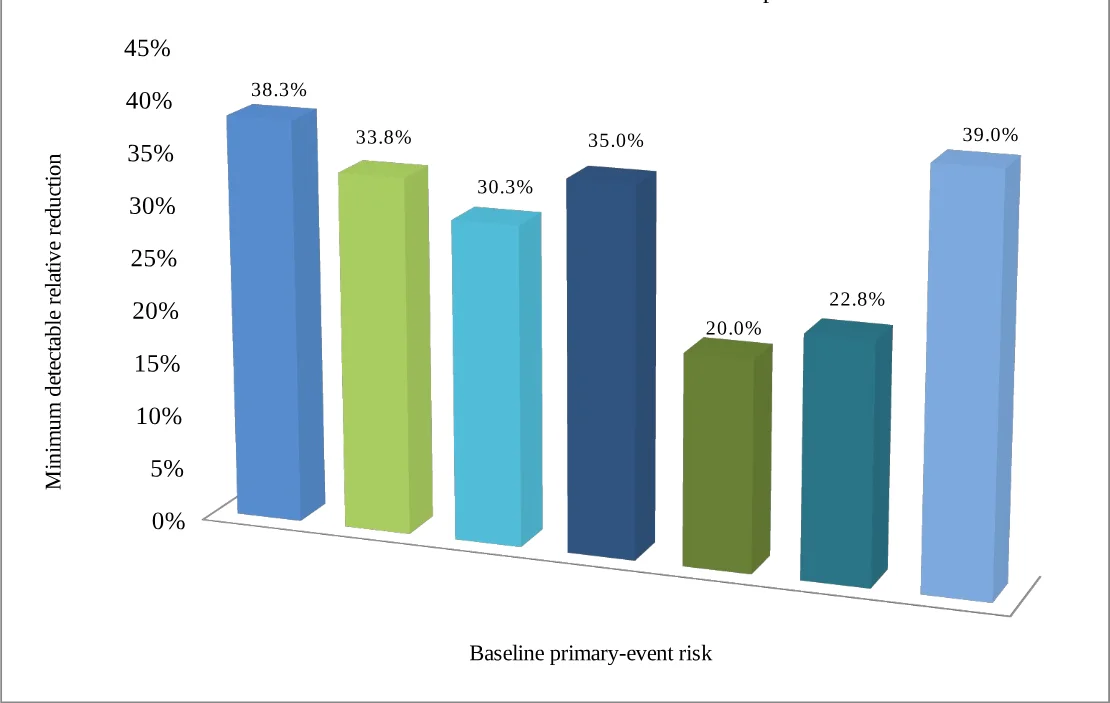
At a 20% baseline risk, the design requires approximately a 38.3% relative reduction for 80% power. At a 35% risk, the corresponding threshold is about 27.4%, and at a 50% risk it falls to about 20.8%. This gradient supports a primary endpoint that captures clinically meaningful moderate or severe episodes across the season rather than relying only on rare emergency events.
5.5 Effective sample size and retention yield
The relationship between clustering and nominal enrollment is summarized in Figure 6, which shows the effective sample size produced by the 1,080-worker enrollment target across intracluster correlations from zero to 0.10.
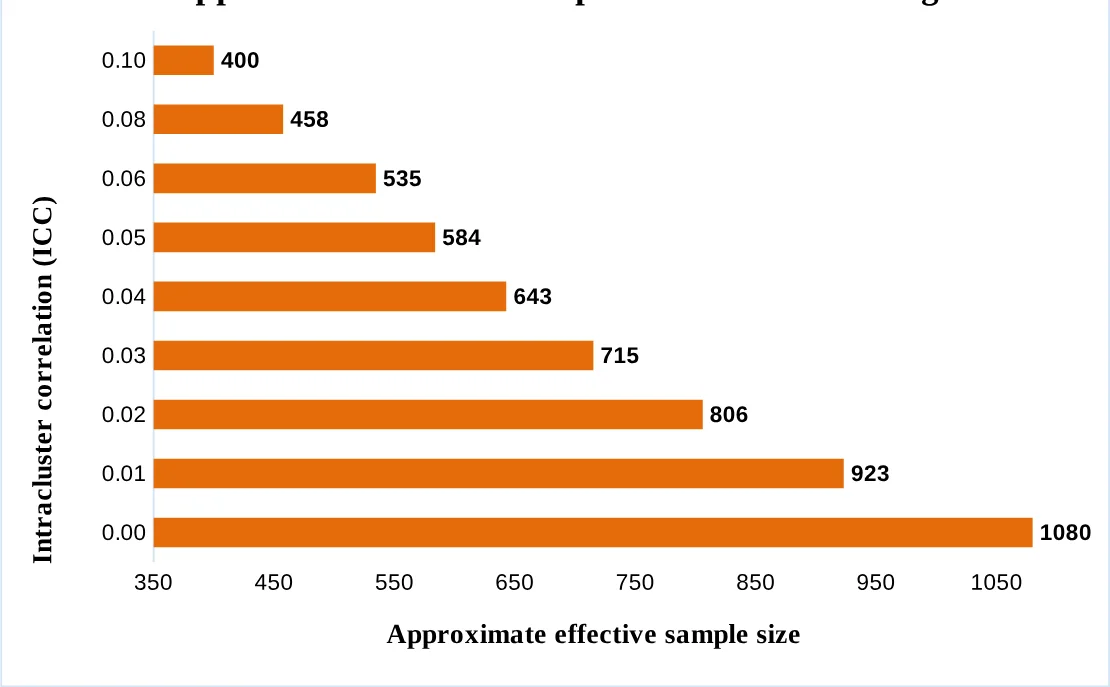
The effective sample declines from 1,080 under independence to about 715 at an intracluster correlation of 0.03 and 584 at 0.05. This loss highlights the importance of accurate crew definition, separation of operational units, and prevention of unnecessary cluster aggregation.
Retention creates a separate source of information loss. Table 6 reports retained workers and potential worker-day observations under prespecified retention scenarios, assuming up to 30 eligible monitored workdays per retained worker.
Table 6. Retention scenarios and potential repeated-measures yield.
| Retention | Retained workers | Potential worker-day records (30 days/worker) |
|---|---|---|
| 80% | 864 | 25,920 |
| 85% | 918 | 27,540 |
| 90% | 972 | 29,160 |
| 95% | 1,026 | 30,780 |
| 100% | 1,080 | 32,400 |
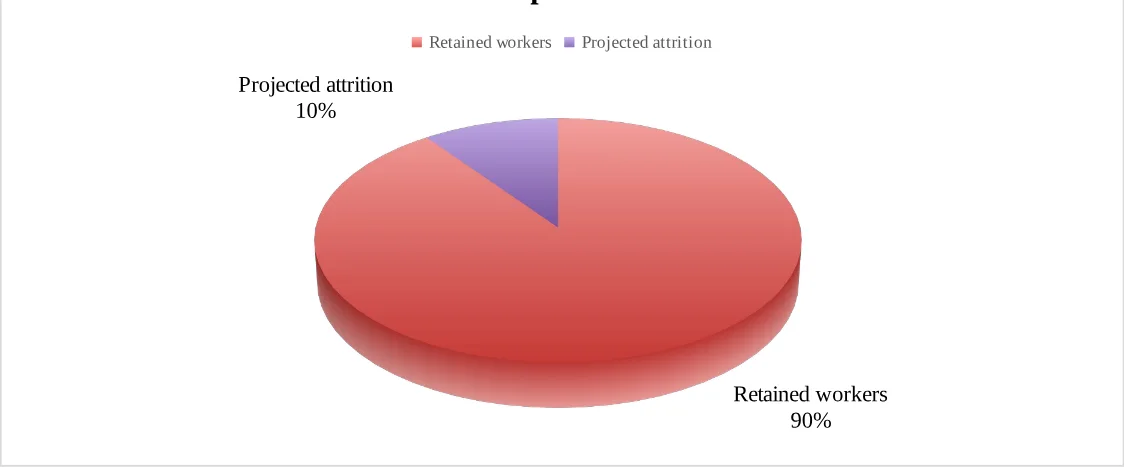
At 90% retention, 972 workers remain and up to 29,160 worker-day records are available for repeated secondary outcomes. Figure 7 shows the planned cohort composition under this central retention scenario (972 retained; 108 not retained). Figure 8 then shows how proportional individual loss affects nominal primary power when all 60 randomized clusters remain represented.
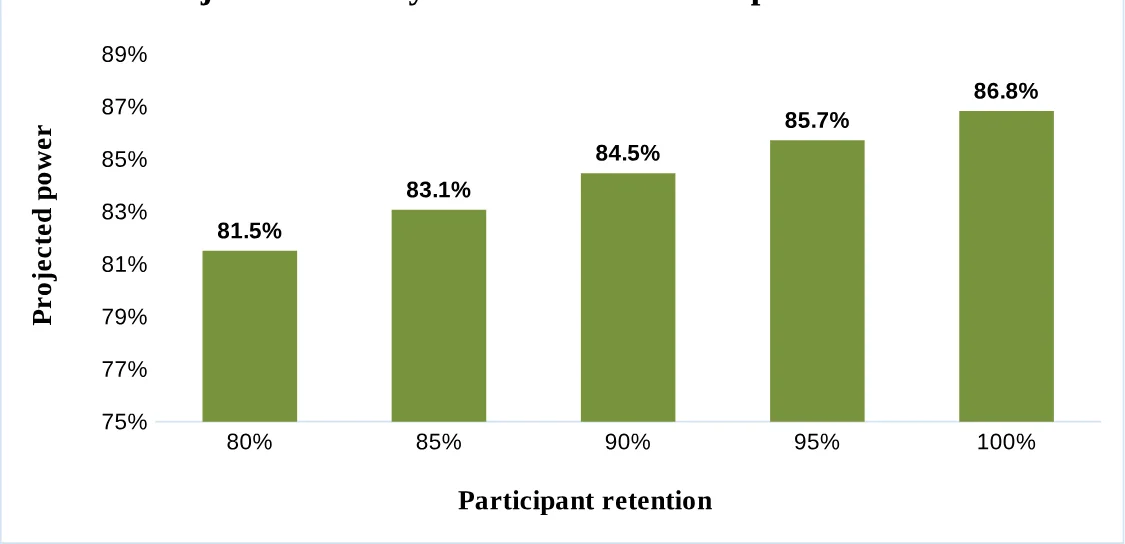
Projected nominal power remains approximately 84.6% at 90% retention and 81.6% at 80% retention, provided all 60 clusters remain represented. Worker-day yield remains substantial even with moderate individual loss, but cluster loss would be more damaging because it reduces both sample size and the number of independent randomized units. Retention management should therefore prioritize continued cluster participation as well as individual follow-up.
5.6 Interpretation boundaries and inferential limits
These operating characteristics are design outputs rather than participant findings. They define what the proposed trial is positioned to estimate and where uncertainty will remain. The SMS cooling interaction is expected to be less precise than either factorial main effect because interaction information is distributed across four arms; it is therefore a secondary estimand with emphasis on effect size and confidence intervals. No health effect, adherence rate, physiological change, or productivity difference is reported at this stage. The calculations also show why a rare emergency-only endpoint would be poorly matched to the sample: event scarcity would widen uncertainty even when severe outcomes remain clinically important. Trial conclusions will depend on observed event frequency, realized ICC, cluster retention, intervention fidelity, contamination, missingness, and the heat-exposure distribution during follow-up. Reporting will therefore pair point estimates with confidence intervals and implementation measures for every prespecified factorial contrast.
6. Discussion
The proposed trial addresses a specific weakness in occupational heat protection: alerts communicate risk, yet the capacity to act depends on resources and work organization. The factorial design separates those mechanisms. A lower heat-illness risk in the SMS arms would support the proposition that timely, forecast-linked communication changes protective behavior beyond usual workplace information. A stronger cooling main effect would indicate that material opportunity is the dominant constraint. An interaction favoring the combined arm would support the central “beyond alerts” proposition: information becomes more effective when workers receive practical means to translate advice into hydration, shade, recovery, and earlier symptom response.
This interpretation extends recent occupational experiments rather than duplicating them. The TEMP cluster trial demonstrated that a bundled package of training, equipment, monitoring and warning, and workplace communication reduced occupational heat-related illness among outdoor power-grid workers (Ding et al., 2025). Its strength was real-world cluster implementation, while its multi-component structure left the contribution of each intervention mechanism unresolved. The proposed 2×2 design trades some simplicity for greater causal resolution. It directly estimates whether a low-cost SMS component adds value, whether cooling support adds value, and whether their joint delivery produces a larger response than either component alone.
The design also responds to findings from agricultural intervention research. Crew-level education combined with supervisor decision support has been feasible under field conditions and has supported repeated physiological assessment (Chavez Santos et al., 2022). Such programs emphasize that heat protection occurs within a social and supervisory system rather than solely through worker knowledge. The present framework incorporates that insight by measuring supervisor support, break access, message uptake, and cooling-resource use. These implementation variables are not treated as peripheral process indicators; they distinguish failure of intervention delivery from failure of the underlying causal mechanism.
Cooling research further supports the material component while cautioning against assuming that every device produces equal benefit. Practical combinations of hydration, wet towels, fans, and recovery areas reduced thermal strain in a hot industrial setting (Bach et al., 2024), Whereas controlled work simulations relevant to Bangladesh show that low-cost cooling strategies differ in effectiveness by configuration and worker characteristics (Smallcombe et al., 2025). The proposed cooling package therefore prioritizes accessible water, shade, reusable cooling towels, and structured recovery rather than relying on a single wearable technology. This configuration is more compatible with mobile urban work and easier to implement across contractors with unequal infrastructure.
The theoretical contribution lies in treating protective action as the product of both risk appraisal and action enablement. Heat-adapted Protective Action Decision Model research links warnings, risk perception, stakeholder trust, and action recommendations with protective motivation and behavior (Heidenreich & Thieken, 2024). The trial adds an experimental resource layer to that behavioral structure. If SMS improves knowledge without changing illness in the absence of cooling support, the result would separate informational success from health-effectiveness failure. Conversely, a cooling effect without an SMS effect would indicate that workers already recognize heat risk but lack feasible protection.
Methodologically, cluster randomization matches the organizational unit through which breaks, water, shade, and supervisory practices are delivered, while the factorial structure uses all 60 clusters to estimate each main effect. Repeated environmental and worker measurements reduce reliance on forecast temperature as a proxy for internal strain. Important limitations remain: the protocol is powered for moderate main effects rather than small effects or interactions; visible interventions cannot be masked; symptom outcomes may be susceptible to reporting differences; and the design-stage power calculations depend on assumptions about event risk, ICC, and cluster retention. These limitations are addressed through allocation-masked severe-event adjudication, objective exposure measurement, co-primary multiplicity control, explicit fidelity measurement, and sensitivity analyses. The policy value lies in identifying the minimum scalable package rather than showing only that a complex bundle works. Component-specific estimates will also support later economic evaluation because SMS delivery and cooling infrastructure have different recurrent costs, staffing requirements, and scaling constraints.
7. Conclusion
Urban outdoor workers face a growing heat burden that is poorly addressed by warning systems when recommended actions remain difficult to perform during paid manual work. This study is designed to determine whether forecast-triggered SMS warnings and low-cost cooling support reduce occupational heat illness independently and jointly among work crews in Dhaka, Bangladesh. A pragmatic 2×2 factorial cluster-randomized design with 60 clusters and approximately 1,080 workers separate communication from material action enablement while preserving implementation under real work conditions. The primary outcome is season-level moderate or severe heat illness, supported by physiological, hydration, behavioral, work-interruption, and productivity measures.
Design-stage operating characteristics indicate that the planned sample provides approximately 87% nominal power for a 30% relative main-effect reduction under a 35% baseline risk and ICC=0.03, with approximately 80% power under a conservative α=0.025 sensitivity for the two co-primary main effects. These calculations are planning results, not participant outcomes. The study's main contribution is causal identification of the minimum intervention package required to move from risk awareness to feasible protection. Limitations include lower precision for the factorial interaction, inability to mask visible interventions, potential symptom-reporting bias, and context-specific generalizability. Future research requires replication across occupations, cities, sexes, pay systems, and climatic conditions, followed by cost-effectiveness and implementation studies using observed intervention effects. The protocol also permits transparent interpretation of null results by separating low message uptake, inadequate cooling access, weak behavioral response, cluster loss, and insufficient statistical precision.
8. Recommendations
Heat-protection programs for urban outdoor workers require paired attention to communication and response capacity. Employers and municipal agencies are recommended to establish forecast-linked protocols that connect heat-risk messages with immediate access to potable water, shaded recovery, cooling materials, and protected micro-breaks. SMS content requires short Bangla instructions, explicit action thresholds, severe-symptom escalation guidance, and timing before work begins, with additional reinforcement during the highest-risk periods. Implementation requires crew-level accountability. Supervisors need documented responsibility for resource availability, break access, and emergency escalation, while workers require protection from wage or disciplinary penalties associated with protocol-compliant rest. Environmental monitoring needs site-level wet-bulb globe temperature rather than reliance on general air temperature alone. Program evaluation requires separate tracking of message delivery, message recall, resource availability, resource use, symptoms, physiological strain, and work outcomes. Where budgets are constrained, component-specific trial estimates will support prioritization of the intervention element producing the largest health gain per unit cost. Scale-up is warranted only after observed trial results confirm effectiveness, fidelity, and acceptable operational burden. Procurement plans also require replacement schedules for cooling materials and uninterrupted water supply during forecast heat episodes.
Author Contributions
Conceptualization, methodology, trial design, statistical analysis planning, visualization, drafting, and critical revision were undertaken by the author team. All authors approved the final manuscript.
Conflict of Interest
The authors declare no conflict of interest.
References
- Bach, A. J. E., Thepaksorn, P., Hom Thepaksorn, E. K., Borg, D. N., Rutherford, S., Osborne, N. J., Darssan, D., & Phung, D. (2024). Practical cooling interventions for preventing heat strain in indoor factory workers in Thailand. American Journal of Industrial Medicine, 67(6), 556–561. https://doi.org/10.1002/ajim.23589
- Binazzi, A., Levi, M., Bonafede, M., Bugani, M., Messeri, A., Morabito, M., Marinaccio, A., & Baldasseroni, A. (2019). Evaluation of the impact of heat stress on the occurrence of occupational injuries: Meta‐analysis of observational studies. American Journal of Industrial Medicine, 62(3), 233–243. https://doi.org/10.1002/ajim.22946 Chandra N, S. V. S., & Lee, J. K. W. (2025). A Systematic Review of Heat Health Warning Systems: Enhancing the Framework Towards Effective Health Outcomes. Current Environmental Health Reports, 12(1), 31. https://doi.org/10.1007/s40572-025-00496-5
- Chavez Santos, E., Spector, J. T., Egbert, J., Krenz, J., Sampson, P. D., Palmández, P., Torres, E., Blancas, M., Carmona, J., Jung, J., & Flunker, J. C. (2022). The effect of the participatory Heat Education and Awareness Tools (HEAT) intervention on agricultural worker physiological heat strain: Results from a parallel, comparison, group allocated study. BMC Public Health, 22(1), 1746. https://doi.org/10.1186/s12889-022-14144-2
- Dasgupta, S., Van Maanen, N., Gosling, S. N., Piontek, F., Otto, C., & Schleussner, C.-F. (2021). Effects of climate change on combined labour productivity and supply: An empirical, multi-model study. The Lancet Planetary Health, 5(7), e455–e465. https://doi.org/10.1016/S2542-5196(21)00170-4
- Ding, R., Wang, Y., Yu, Y., Meng, X., Gong, Q., Tang, Y., Wang, J., Mu, X., Li, H., Zhou, H., Wang, S., & Liu, P. (2025). Effectiveness of a Multifaceted Intervention (TEMP) for Prevention of Occupational Heat-Related Illness among Outdoor Workers in the Power Grid Industry: A Cluster Randomized Controlled Trial. Environmental Health Perspectives, 133(1), 017001. https://doi.org/10.1289/EHP14172
- Ebi, K. L., Capon, A., Berry, P., Broderick, C., De Dear, R., Havenith, G., Honda, Y., Kovats, R. S., Ma, W., Malik, A., Morris, N. B., Nybo, L., Seneviratne, S. I., Vanos, J., & Jay, O. (2021). Hot weather and heat extremes: Health risks. The Lancet, 398(10301), 698–708. https://doi.org/10.1016/S0140-6736(21)01208-3
- Foster, J., Hodder, S. G., Goodwin, J., & Havenith, G. (2020). Occupational Heat Stress and Practical Cooling Solutions for Healthcare and Industry Workers During the COVID-19 Pandemic. Annals of Work Exposures and Health, 64(9), 915–922. https://doi.org/10.1093/annweh/wxaa082
- Foster, J., Smallcombe, J. W., Hodder, S., Jay, O., Flouris, A. D., Nybo, L., & Havenith, G. (2021). An advanced empirical model for quantifying the impact of heat and climate change on human physical work capacity. International Journal of Biometeorology, 65(7), 1215–1229. https://doi.org/10.1007/s00484-021-02105-0
- Habibi, P., Moradi, G., Dehghan, H., Moradi, A., & Heydari, A. (2021). The impacts of climate change on occupational heat strain in outdoor workers: A systematic review. Urban Climate, 36, 100770. https://doi.org/10.1016/j.uclim.2021.100770
- Hansson, E., Glaser, J., Weiss, I., Arias-Monge, E., Pacheco-Zenteno, F., Raines, N. H., Silva-Peñaherrera, M., Vasquez, J., Castellón, Z. E., Poveda, S., Cerda-Granados, F. I., Martinez-Cuadra, W., Chavarria, D., Lucas, R. A. I., Ekström, U., Jakobsson, K., Wesseling, C., & Wegman, D. H. (2025). Rest, shade, hydration and hygiene for the prevention of kidney injuries and inflammation in a Nicaraguan sugarcane worker cohort. Occupational and Environmental Medicine, 82(6), 270–277. https://doi.org/10.1136/oemed-2025-110128
- Hansson, E., Jakobsson, K., Glaser, J., Wesseling, C., Chavarria, D., Lucas, R. A. I., Prince, H., & Wegman, D. H. (2024). Impact of heat and a rest-shade-hydration intervention program on productivity of piece-paid industrial agricultural workers at risk of chronic kidney disease of nontraditional origin. Annals of Work Exposures and Health, 68(4), 366–375. https://doi.org/10.1093/annweh/wxae007
- Hass, A. L., Runkle, J. D., & Sugg, M. M. (2021). The driving influences of human perception to extreme heat: A scoping review. Environmental Research, 197, 111173. https://doi.org/10.1016/j.envres.2021.111173
- He, C., Zhang, Y., Schneider, A., Chen, R., Zhang, Y., Ma, W., Kinney, P. L., & Kan, H. (2022). The inequality labor loss risk from future urban warming and adaptation strategies. Nature Communications, 13(1), 3847. https://doi.org/10.1038/s41467-022-31145-2
- Heidenreich, A., & Thieken, A. H. (2024). Individual heat adaptation: Analyzing risk communication, warnings, heat risk perception, and protective behavior in three German cities. Risk Analysis, 44(8), 1788–1808. https://doi.org/10.1111/risa.14278
- Hesketh, M., Wuellner, S., Robinson, A., Adams, D., Smith, C., & Bonauto, D. (2020). Heat related illness among workers in Washington State: A descriptive study using workers’ compensation claims, 2006‐2017. American Journal of Industrial Medicine, 63(4), 300–311. https://doi.org/10.1002/ajim.23092
- Ioannou, L. G., Foster, J., Morris, N. B., Piil, J. F., Havenith, G., Mekjavic, I. B., Kenny, G. P., Nybo, L., & Flouris, A. D. (2022). Occupational heat strain in outdoor workers: A comprehensive review and meta-analysis. Temperature, 9(1), 67–102. https://doi.org/10.1080/23328940.2022.2030634
- Issa, M. A., Chebana, F., Masselot, P., Campagna, C., Lavigne, É., Gosselin, P., & Ouarda, T. B. M. J. (2021). A heat-health watch and warning system with extended season and evolving thresholds. BMC Public Health, 21(1), 1479. https://doi.org/10.1186/s12889-021-10982-8
- Kotharkar, R., & Ghosh, A. (2022). Progress in extreme heat management and warning systems: A systematic review of heat-health action plans (1995-2020). Sustainable Cities and Society, 76, 103487. https://doi.org/10.1016/j.scs.2021.103487
- Li, T., Chen, C., & Cai, W. (2022). The global need for smart heat–health warning systems. The Lancet, 400(10362), 1511–1512. https://doi.org/10.1016/S0140-6736(22)01974-2
- Lucas, R. A., Skinner, B. D., Arias-Monge, E., Jakobsson, K., Wesseling, C., Weiss, I., Poveda, S., Cerda-Granados, F. I., Glaser, J., Hansson, E., & Wegman, D. H. (2023). Targeting workload to ameliorate risk of heat stress in industrial sugarcane workers. Scandinavian Journal of Work, Environment & Health, 49(1), 43–52. https://doi.org/10.5271/sjweh.4057 Lung, S.-C. C., Liou, M.-L., Yeh, J.-C. J., & Hwang, J.-S. (2023). A pilot heat-health warning system co-designed for a subtropical city. PLOS ONE, 18(11), e0294281. https://doi.org/10.1371/journal.pone.0294281
- Masuda, Y. J., Garg, T., Anggraeni, I., Ebi, K., Krenz, J., Game, E. T., Wolff, N. H., & Spector, J. T. (2021). Warming from tropical deforestation reduces worker productivity in rural communities. Nature Communications, 12(1), 1601. https://doi.org/10.1038/s41467-021-21779-z
- Morrissey-Basler, M. C., Brewer, G. J., Anderson, T., Adams, W. M., Navarro, J. S., Marcelino, M., Martin, D. G., & Casa, D. J. (2024). The effect of heat mitigation strategies on thermoregulation and productivity during simulated occupational work in the heat in physically active young men. Frontiers in Sports and Active Living, 5, 1274141. https://doi.org/10.3389/fspor.2023.1274141
- Parsons, L. A., Shindell, D., Tigchelaar, M., Zhang, Y., & Spector, J. T. (2021). Increased labor losses and decreased adaptation potential in a warmer world. Nature Communications, 12(1), 7286. https://doi.org/10.1038/s41467-021-27328-y
- Shahrujjaman, S. M., Sikder, B. B., Zahid, D., & Uddin, S. I. (2025). Comparative study of heat-related symptoms among indoor and outdoor informal workers: A pilot study in Dhaka, Bangladesh. The Journal of Climate Change and Health, 26, 100576. https://doi.org/10.1016/j.joclim.2025.100576
- Smallcombe, J. W., Ranhotty, R. N., Bach, A. J. E., Palutikof, J. P., Tonmoy, F. N., Joarder, A. R., Hossain, M., Morris, N. B., Capon, A., Mavros, Y., & Jay, O. (2025). Sustainable cooling strategies for workers in the ready-made garment factory industry in Bangladesh under simulated extreme heat: A randomised crossover trial. The Lancet Planetary Health, 9(9), 101317. https://doi.org/10.1016/j.lanplh.2025.101317
- Spector, J. T., Masuda, Y. J., Wolff, N. H., Calkins, M., & Seixas, N. (2019). Heat Exposure and Occupational Injuries: Review of the Literature and Implications. Current Environmental Health Reports, 6(4), 286–296. https://doi.org/10.1007/s40572-019-00250-8
- Tigchelaar, M., Battisti, D. S., & Spector, J. T. (2020). Work adaptations insufficient to address growing heat risk for U.S. agricultural workers. Environmental Research Letters, 15(9), 094035. https://doi.org/10.1088/1748-9326/ab86f4
- VanderMolen, K., Kimutis, N., & Hatchett, B. J. (2022). Recommendations for increasing the reach and effectiveness of heat risk education and warning messaging. International Journal of Disaster Risk Reduction, 82, 103288. https://doi.org/10.1016/j.ijdrr.2022.103288
- Zhao, M., Huang, X., Kjellstrom, T., Lee, J. K. W., Otto, M., Zhang, X., Romanello, M., Zhang, D., & Cai, W. (2022). Labour productivity and economic impacts of carbon mitigation: A modelling study and benefit–cost analysis. The Lancet Planetary Health, 6(12), e941–e948. https://doi.org/10.1016/S2542-5196(22)00245-5
CITE THIS ARTICLE
Afrin, S. (2026). Beyond Heat Alerts: A Cluster-Randomized Trial of SMS Warnings and Cooling Support among Urban Outdoor Workers. https://www.researchbysadia.com/article/2bb84f60-c2ca-4d0a-8db6-fc2452af02a3
S. Afrin, “Beyond Heat Alerts: A Cluster-Randomized Trial of SMS Warnings and Cooling Support among Urban Outdoor Workers,” 2026. [Online]. Available: https://www.researchbysadia.com/article/2bb84f60-c2ca-4d0a-8db6-fc2452af02a3
Afrin, S. (2026) ‘Beyond Heat Alerts: A Cluster-Randomized Trial of SMS Warnings and Cooling Support among Urban Outdoor Workers’. Available at: https://www.researchbysadia.com/article/2bb84f60-c2ca-4d0a-8db6-fc2452af02a3
Afrin, Sadia. “Beyond Heat Alerts: A Cluster-Randomized Trial of SMS Warnings and Cooling Support among Urban Outdoor Workers.” 2026, https://www.researchbysadia.com/article/2bb84f60-c2ca-4d0a-8db6-fc2452af02a3.
Sadia Afrin. “Beyond Heat Alerts: A Cluster-Randomized Trial of SMS Warnings and Cooling Support among Urban Outdoor Workers.” (2026). https://www.researchbysadia.com/article/2bb84f60-c2ca-4d0a-8db6-fc2452af02a3.
Afrin S. Beyond Heat Alerts: A Cluster-Randomized Trial of SMS Warnings and Cooling Support among Urban Outdoor Workers. 2026. https://www.researchbysadia.com/article/2bb84f60-c2ca-4d0a-8db6-fc2452af02a3
@misc{article_2bb84f60c2ca4d0a8db6fc2452af02a3,
  title = {Beyond Heat Alerts: A Cluster-Randomized Trial of SMS Warnings and Cooling Support among Urban Outdoor Workers},
  author = {Sadia Afrin},
  year = {2026},
  url = {https://www.researchbysadia.com/article/2bb84f60-c2ca-4d0a-8db6-fc2452af02a3},
}
TY - GEN AU - Sadia Afrin TI - Beyond Heat Alerts: A Cluster-Randomized Trial of SMS Warnings and Cooling Support among Urban Outdoor Workers PY - 2026 UR - https://www.researchbysadia.com/article/2bb84f60-c2ca-4d0a-8db6-fc2452af02a3 ER -