Bangladesh is vulnerable to recurrent floods, cyclones, salinity intrusion, river erosion and livelihood disruption, but the adaptation finance is not consolidated. The local adaptation finance is fragmented among institutions and funding channels in the context of recurrent floods, cyclones, salinity intrusion, river erosion and livelihood disruption in Bangladesh. This study examines the relationship between the concepts of public grants, local co-financing, multi-level governance and household livelihood support to community resilience. A comparative design based on secondary data also incorporates validated climate finance data from Local Government Initiatives, district intervention information, and a climate adaptive livelihood assessment for 1,011 beneficiaries. Results reveal that USD 12.26 million of household resilience grants were awarded and USD 9.14 million of performance-based local-government grants were awarded, with 68% of local schemes indicating that they had received co-financing. The vulnerability- and performance-oriented allocation is hardly reflected in the allocation of Scheme in seven districts, where the amounts of the schemes are almost independent of the number of beneficiaries. There is a significant difference in the resilience outcomes between the different agro-ecological settings: food security is 98.8% in the Active Tista Floodplain and 48.9% in the Ganges Tidal Floodplain. The increased fiscal traceability, locally accountable governance, transparent inclusion, and private-capital reporting are key to scalable adaptation finance.
Research ArticleClimate Finance and GovernanceIn progress
Financing Local Climate Adaptation and Disaster Risk Reduction: Public–Private Funding, Multi-Level Governance, and Community Resilience in Climate-Vulnerable Regions in Bangladesh
Correspondence: safrin2468@gmail.com
Abstract
Keywords Climate adaptation financedisaster risk reductionmulti-level governancecommunity resiliencepublic–private fundingBangladesh
1. Introduction
Climate adaptation and disaster risk reduction are combined in development priorities in highly exposed deltaic settings. Internationally, local and incremental adaptation is still the norm and there are ongoing uneven and inadequate efforts to measure adaptation impacts and scale up institutions over time[1], [2]. Bangladesh prioritizes this challenge to a very dense geography which is at risk from river flood, flash flooding, cyclones, storm surge, salinity intrusion, erosion, water logging, drought and landslide risk. In response, rural households diversify their livelihoods, adapt their production, shift their location, rely on informal financial sources and gain information through informal channels, and/or shift to other destinations as their assets perish repeatedly and they lack liquidity, information and market access. Collective infrastructure, early warning, water management, livelihood support, recovery planning etc. require coordinated action which is where local institutions have a key role between the coping strategies of households and national climate policy[3].
There's an issue of financing, not only in terms of the quantity of funding for climate, but also the distribution of climate funding. The time, inclusion and accountability of the provision of resources to vulnerable households and local governments will determine the possibility of adaptation. Studies on community resilience in Bangladesh suggest that there are positive associations between community-level institutional capacity, coordination between levels, technical capability, fiscal autonomy and decisions that are accountable and participatory [4]. On the household level, the association of receipt of HLF with higher household participation in adaptation actions has been observed, but this does not lower the level of receipt of adaptation costs, rather it continues to be met through income and savings and borrowing [5]. Distributional questions are also raised from a climate justice perspective on adaptation finance as it concerns who provides the finance, who is prioritized and if there are governance bodies, who is included in and at the heart of the allocation of vulnerability. The question of these concerns is particularly pertinent in LGOUs with limited own-source funds and that are highly dependent on transfers, projects or externally funded programmes.
The second issue is related with multi-level governance. In Bangladesh, adaptation to climate change and its impacts is a collective responsibility of the local government, donors, NGOs, communities, market and households. According to the research on the network[6], [7]. national organizations will have a high influence on the network, even if they don't have bottom-up processes in planning, implementation and monitoring. There are also differences between local disaster-management networks with respect to collaboration – there is more collaboration in preparedness and response than in recovery and mitigation, indicating a coordination gap throughout the disaster-management process [8]. Other strands of adaptive governance studies include the concept of 'institutional fit' and 'bridging organizations', iterative learning and collaborative trans-scalar and trans-institutional processes [9]. If planning capacity, local authority and social learning/monitoring is missing, finance without these can result in short-term outputs and not long-term resilience.
The third is the absence of public funds integration with market resources, community resources and the resources of the private sector. The experiences of livelihood reconstruction after the devastating cyclones demonstrate that livelihood resilience is underpinned by diversification, social capital and learning and the potential to rethink livelihoods post-shocks [10]. In terms of financing, private sector involvement in adaptation goes beyond providing direct financing to the provision of supply chains, services, information, market creation and implementation partnerships [11]. It therefore becomes necessary to identify analytical tools which are able to distinguish between public funds, donor funds, local-government contribution and community co-finance and private funds, and not to group all funds that are not central together in one funding category. This is important for assessing leverage, additionality and financial sustainability.
The literatures on household adaptation, local governance, institutions of disasters and implementation of climate finance in Bangladesh so far are weak in connecting the existing knowledge. The hazard prone riverine islands are highlighted in the hazard research and gap is between formal climate finance and the village level; and in the policy-community analysis there is a gap between centralization and reactiveness. Another reported constraint to coastal resilience building performance is voice, accountability and institutional weakness[12], [13],[14]. in the coastal areas. The national synthesis reveals that adaptation research is expanding but not yet systematic, and that hardly any research is conducted on linkages between interventions, institutions, livelihoods and social-ecological conditions overall[15]. One particular gap relates to the empirical connection between financing architecture, local allocation, co-financing, multi-level governance and tangible resilience outcomes in a single analysis.
The study fills this gap by conducting a comparative secondary-data assessment of the Local Government Initiative on Climate Change (LoGIC), using programme-finance information, district-level information on interventions and reported outcomes from the Climate Adaptive Livelihood Options assessment. The objective is to gain insights into institutional and financial connections between local adaptation and disaster risk financing in Bangladesh in climate vulnerable regions and how these can be linked to different aspects of a resilient response. This analysis addresses specific questions regarding four goals: the extent and amount of adaptation finance reaching households and local governments; the extent of adaptation finance reaching livelihoods and food security; how outcomes for livelihoods, food security and adaptive capabilities vary across hazard ecologies; and the impact of co-financing and multi-level governance on scalability and financial traceability. Matching research questions are: How are resources allocated across financing channels; How is the allocation of resources and scheme deployment related to volume of beneficiaries; How do outcomes with respect to resilience vary across agro-ecological settings; Where are there gaps in governance or private-capital reporting. It is an integrated assessment of finance to resilience, which sees fiscal design and allocation rules, local institutions and household outcomes as a joint system and not just policy spheres.
2. Literature Review
2.1 Local Adaptation Finance and Distributional Effectiveness
Local adaptation finance has two interrelated functions: it eases the liquidity constraints of households and provides collective goods that can benefit other households as well. Financial access is linked to livelihoods changes, agricultural changes, and other risk management measures in Bangladesh [2], and community institutions contribute to the organization of local adaptation knowledge [3]. But effectiveness is not just about disbursement – it's about distribution, timing, eligibility and institutional reach. Household self-financing and borrowing can be combined with formal climate support [5]. Climate-justice scholarship also holds that allocation quality depends on the vulnerability and procedural justice and local priority setting. Assessment of the local finances is therefore needed both on a household level and on a collective-infrastructure level.
Indigenous research in Bangladesh shows a lag in the delivery of formal financial mechanisms and their local impacts. The riverine-island research reveals a lack of participatory implementation and influence at the village level on climate finance governance [6], [12], and environmental governance analysis highlights the lack of protection at the village level in hazard-prone rural areas [17]. These results are contrary to input-centered assessment, where more spending is seen as more success. Stronger assessment: Who gets financing, what adaptation function is financed, how priorities are determined, and whether results are better at various hazard ecologies. The emphasis as a consequence is moved from nominal expenditure to finance intensity, allocation logic, institutional access and resilience performance.
2.2 Public–Private and Community Co-Financing
Public finance continues to play a key role in adaptation, however, due to the diffuse social benefits, long payback periods, uncertain revenue streams and weak direct monetization of many resilience investments. However, private sector involvement brings the benefits of market access, technology, credit linkages, input provision, capacity to implement, and business continuity. The research on enabling environments highlights that, the lack of infrastructure, imperfect financial markets, information constraints and institutional weaknesses are barriers to private adaptation activity [16]. Multilateral portfolio analysis also reveals that private involvement is not just in the formal co-finance, but also in operational, market, and service domain [11]. Risk and incentive structuring by public resources around locally valued adaptation are the pertinent analytical issues.
There is also a distributional aspect in co-financing. Adaptation-finance justice research indicates that the use of leverage targets can become problematic if it diverts the focus from very vulnerable groups or if it is transferring financial risk to households that have little ability to repay. This worry is confirmed by the household-level results in Bangladesh, as people continue to rely on savings and loans [5], [6]. Community-based adaptation research also indicates that diminished legitimacy occurs when external timelines, accountability frameworks and predetermined interventions are more salient to community priorities [20]. There should thus be a clear identification of contributors, counterpart value, financial form, and risk distribution in order to be effective. An analysis of a high co-financing rate does not lead to the determination of the volume of truly private capital, nor the extra contribution of resilience from it.
2.3 Multi-Level Governance, Fiscal Authority, and Institutional Coordination
Multi-level governance conceptualizes adaptation as a vertical and horizontal process that refers to a range of policy and administration levels, as well as civil society, communities and market actors. The formal decentralization along with high level of national influence on adaptation decision making has been observed in Bangladesh in the research [7]. There are several actors in local disaster-management networks, but the collaboration is decreased in recovery and mitigation phase compared to preparedness and response phase [8]. Research on good-governance conditions for local resilience reveals the key conditions of autonomy, technical capacity, accountability, participation and cross-scale linkages [4]. The core message is that there is a need for complementary authority and institutional capacity where the climate risk is felt, and this needs to be backed by fiscal transfers.
Adaptive-governance research studies extend this argument by incorporating the concepts of institutional fit, repeated learning and bridging across administrative scales [9]. Reactive, centralised strategies are found to have low representation of local livelihood priorities in policy-community studies [13]. An analogue governance challenge to this occurs in riverine contexts: formal arrangements for climate finance work better above the village level [12]. It is a governance issue, not a lack of plans, then, that is at odds between the extensive policy architecture and uneven local execution. Important issues to attend to for assessment are the allocation formulas, performance incentives, quality of planning, monitoring, administrative discretion, and community voice in the fiscal-transfer process.
2.4 Community Resilience, Livelihood Diversification, and Social Learning
Community resilience is about the ability to sustain or rebuild sectors and activities that are vital to social and livelihood well-being, re-organize following shocks and adapt to shifts in risk. According to Bangladesh studies, there are post disaster pathways which include coping, coping adaptation, occupational change and transformational livelihood change [10]. According to transformative-learning research, knowledge contributes to resilience only when it is followed by feasible action and enabling social conditions, are also present [18]. Previous studies have shown that indigenous knowledge, social memory, power issues and institutions influence social learning processes [19]. Livelihood diversification and learning is not then just a household decision, but occurs within the broader context of governance.
The level of resilience varies among social groups and hazard contexts. The adaptation practices in the river erosion area depend on livelihood resources and availability of finance and information [2]. The participation of local institutions enhances relationship and technical results, though is impacted by collective-action and coordination issues [3]. Social-justice risks with community-based programmes exist if participation is limited or defined by external organizations with a limited understanding of community [20]. The multidimensional evaluation is thus recommended to single resilience score, particularly in coastal tidal plains, estuarine floodplains, riverine floodplains and wetland basins where livelihood constraints vary.
2.5 Synthesis and Unresolved Integration Gap
The literature identifies five interrelated relationships: Resilience outcomes depend on the context of the hazard and livelihood; Resilience outcomes depend on learning; Local institutions enter into the picture of access and implementation; multi-level governance is involved in the picture of authority and accountability; Finance relaxes resource constraints [1], [7], [9], [15]. Such relationships are usually explored in different designs. There is little evidence to link the forms of disbursement with intensity of district provision and resilience measures in finance studies, and very little in governance studies quantifies the funding flows through local institutions. Another gap is the lack of local financing data for engagement, even though engagement is discussed, the local financing data is not actor-disaggregated in the private sector [11], [16].
Cost, delivery, allocation, governance, co-financing, and resilience outcome must all be taken into account simultaneously in an integrated design. But is there a link between observable funding architectures and vulnerability-sensitive local government and measurable resilience’s gains? This integration also brings a measurement difference: co-financing incidence does not equal the volume of private capital. Even though they are part of the same project, they fall into different categories: local-government land, assets of the market-committee, community savings, and contributions from businesses. The present study links these two pairs of variables (i.e. verified programme finance and district measures of allocation and beneficiaries' resilience) while maintaining these distinctions and without resorting to the reconstruction of unobserved microdata.
3. Conceptual and Theoretical Framework
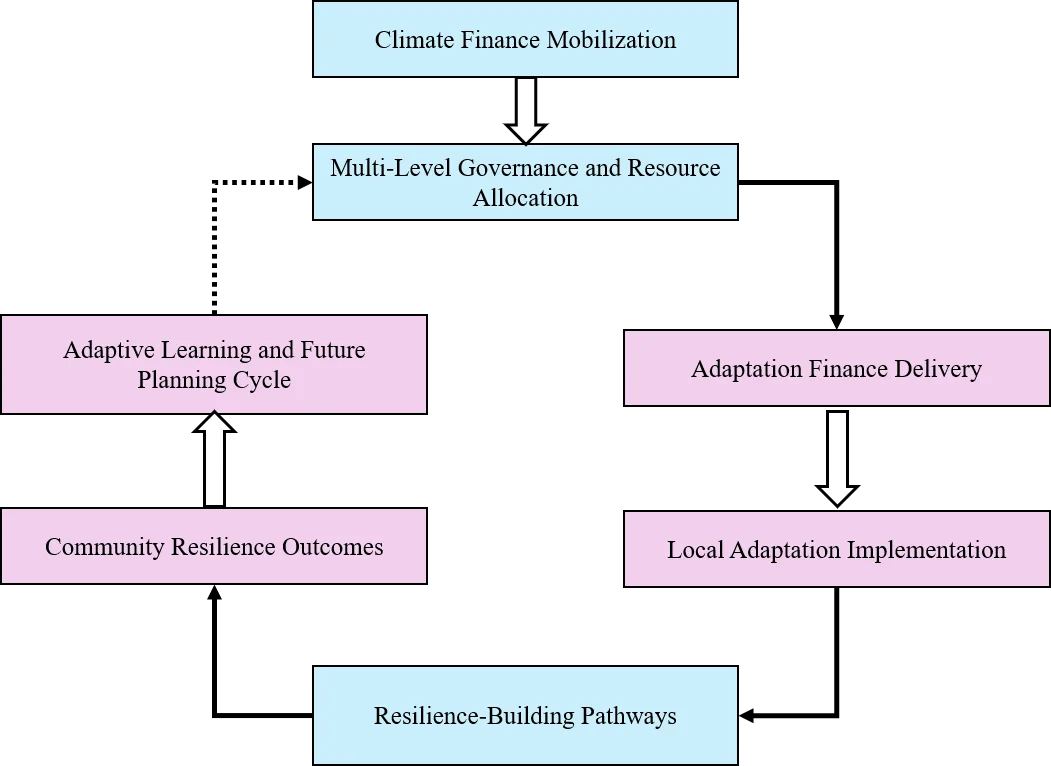
The study has an integrated perspective of finance-to-resilience that integrates multi-level climate governance, adaptive governance and private-adaptation-finance logic. Multi-level governance is used to explain the need for a vertical process of interaction between the national level of institutions, development partners, local government, community groups and households for resilience to be achieved [7], [21]. It also acknowledges the horizontal dimension of the relationships between local governments, market actors, civil-society organizations and service providers. Adaptive governance brings in institutional fit, iterative learning, feedback and bridging relationships, which will ensure whether financial resources turn into context-specific action or not [9]. The private-adaptation-finance research adds a component on market perspective where public funding is used to solve externalities, information problem, and financing issues, and sets up the conditions for commercial and community participation [11].
The two main finance channels are outlined in the framework. Household oriented grants come in through Community Resilience Fund and are directed towards livelihood assets, financial inclusion, adaptive practice. Local-government grants come in through performance-based transfers for climate-resilience and are directed at collective infrastructure and community schemes. Allocation is facilitated through climate vulnerability, local performance, quality of planning, institutional capacity, participation, and monitoring. A complementary mechanism, co-financing, is introduced, in the form of local-government resources, community contributions, the market or a private entity. The importance of actor separation is that counterpart value from a local authority has different leverage implications as compared to private investment or household borrowing.
Finance is not just a matter of expenditure, but has intermediate impacts on resilience. Household grants impact productive assets, diversification, formal financial access and climate adaptive practices. Collective grants affect roads, water systems, market facilities, protective infrastructure and other collective services, which impact the feasibility and returns from household adaptation. The quality of governance affects targeting, maintenance, accountability and the implementation speed. The intermediate outcomes impact food security, adaptive confidence, livelihood stability, and overall community resilience. The framework thus considers financial inclusion and local infrastructure as means, rather than end-results of resilience.
Hazard ecology is also an intervening factor between finance and resilience as a piece of the same project may be valued differently across the four categories of tidal salinity, estuarine flooding, riverine flooding, and wetland exposure. There is a feedback loop connecting outcomes of observation and implementation performance with subsequent local planning, institutional learning, and allocation of grants. It follows from this analytical implication that resilience is not solely a matter of volume of finance, but of: the nature of the finance; how finance is allocated; the capacity of the collaborators to govern; the quality of the co-financing; and the local hazard situation. These relationships are converted to an editable framework in Figure 1, and the organizing logic of the empirical variables and the district comparisons and interpretation that follow.
4. Methodology
4.1 Research Design and Analytical Unit
A comparative secondary-data design was chosen, rather than a newly implemented intervention, firstly because the research question is related to financing architecture, local allocation, governance and measured outcomes of the programme, and secondly because a new intervention would not adequately address the issue of how it is financed. The design ties together three levels of the empirical: programme level finance, district level intervention allocation, and already-reported outcomes at beneficiary level in the programme's cross-sectional livelihood assessment. The primary district comparison refers to the districts of Kurigram, Sunamganj, Khulna, Bagerhat, Barguna, Patuakhali and Bhola where the set-up LoGIC portfolio shows the numbers of beneficiaries for the Community Resilience Fund and the numbers of beneficiaries for the Performance-Based Climate Resilience Grant. The programme indicators also refer to the subsequent expansion in the Chittagong Hill Tracts, as the total programme is stated in this larger area. There is no attempt to describe a causal treatment effect, it is descriptive and associational.
The empirical design retains separate analytical units and denominators for programme-level finance, district-level allocation, and beneficiary-level resilience outcomes.
4.2 Setting and Data Sources
Empirical inputs were taken from validated public documents of the Local Government Initiative on Climate Change and the Climate Adaptive Livelihood Options assessment. The Finance records show cumulative disbursement amounts of the Community Resilience Fund and the Performance Based Climate Resilience Grant, the number of beneficiaries, the number of schemes, the amount of co-financing and selected examples of counterpart-financing. The public district dashboard has details of the numbers of beneficiaries and schemes across the seven similar districts. The results of the Climate Adaptive Livelihood Options study are based on 1011 beneficiaries of the Community Resilience Fund (CRF), including their reports on livelihood earnings responses, food-security status according to agro-ecological zone, confidence in adaptive capacity, and adoption of new crops or animals. Denominator consistency of programme records and outcome tables checked prior to calculation. There were no imputations, reconstructions nor simulations at the household level.
The variables used in the analysis and the extent of safeguards applied to the sources of the variables are shown in Table 1. The table is provided to clearly define the denominator boundaries and to avoid mixing up the denominators for programme-wide totals and those for the seven districts or for each survey.
Table 1. Empirical data sources, scope, and analytical use.
| Public data source | Scope | Extracted fields | Scope safeguard |
|---|---|---|---|
| LoGIC achievement and programme records | Programme aggregate | CRF and PBCRG disbursement; 42,500 CRF recipients; 916 schemes; 68% co-financing | Aggregate ratios only where numerator and denominator share programme scope |
| LoGIC district dashboard | Seven established districts | 35,000 CRF beneficiaries; district beneficiary and scheme count | Cross-district analysis restricted to the seven complete district pairs |
| CALO cross-sectional assessment | 1,011 CRF beneficiaries | Earnings response; food security; adaptive confidence; practice adoption | Published percentages retained; no microdata reconstruction |
| LoGIC documented sales-centre case | Specific local investment | BDT 6.8m PBCRG; BDT 1.7m combined local counterpart | Used as a case illustration; counterpart not classified wholly as private capital |
Data were accessed from official LoGIC/UNDP public project materials. These empirical sources are not included in the journal-article reference list.
4.3 Measures and Variable Construction
The finance composition is the value and the percentage of two major grant sources. The average value of a Community Resilience Fund per reported beneficiary and the average value of a Performance Based Climate Resilience Grant per reported scheme is used as a measure of finance intensity. Geographic intervention intensity is based on the number of schemes per 1,000 Community Resilience Fund beneficiaries and beneficiaries per scheme. The proportion of local schemes funded through co-financing from other sources is reported; a market-linked facility example is only included as a counterpart-finance example because the amount at the actor level is not disclosed at the portfolio level. Community resilience is measured in terms of reported livelihood earnings responses, the prevalence of food security within the household, adaptive-confidence categories and adoption of new crops or animals. A governance-observability indicator captures if key finance components are created at a separation of public, local, community and private contributions.
4.4 Finance and Cross-District Analysis
All currency values were left in their original form and only ratios were calculated when the same currency was used for the numerator and denominator, that is, programme scope. The value per beneficiary for the Community Resilience Fund is calculated as cumulative disbursement/42,500 reported beneficiaries. The value of Performance-Based Climate Resilience Grant per scheme is the amount of the grant for the established portfolio divided by 916-scheme. District metrics are based on the seven-district subset (35,000 beneficiaries of the Community Resilience Fund and all 916 reported schemes). The geographic dispersion is described by the rankings, the ranges and the normalized scheme intensity. Pearson correlation is used to measure the linear association between beneficiary count and scheme count in each of seven districts and Spearman rank correlation is used to test the monotonic association between the ordering of the districts. Coefficients are used as exploratory allocation diagnostics and not parameters of the population, due to the low number of districts.
4.5 Resilience Outcome Analysis and Triangulation
The Climate Adaptive Livelihood Options results were analysed based on the categories reported in the source assessment. Food security is analysed based on the four subbasins of Ganges Tidal Floodplain, Young Meghna Estuarine Floodplain, Active Tista Floodplain and Sylhet Basin. Comparisons are made between the adaptive confidence and the adoption of a few new crop or animal types, in the same zones. For the maize cultivation and native poultry activities the original response meaning of livelihood results is retained: better incomes for maize and no change in income for sunflower and watermelon (where sunflower was dominant). Triangulation establishes a connection between these patterns of outcomes and the financial and governance indicators without combining incompatible denominators. Programme-scale financial inclusion is analyzed separately from the 1,011-person assessment as the published number of beneficiaries is higher. This allows for analytical separation of reach of the programme and prevalence of any outcomes of the survey.
4.6 Validity, Robustness, Bias Control, and Ethics
Validity protections include those regarding provenance, denominator matching and conservative inference. Reported totals were compared between the project dashboard, achievement records and assessment tables and discrepancies as a result of programme expansion were kept as separate scopes and not forced into a single denominator. Independent calculations of derived ratios and two different forms of the district association (Pearson and Spearman) were performed. There was no missing district values estimated. Secondary aggregate data minimize disclosure risk to individuals and do not allow individuals to be identified. The study does not include any new contact with the participants, no experimental manipulation and no collection of personal data that could be sensitive for the participants. Ethical interpretation is about not re-identifying, respecting the categories reported, making sure to avoid assuming causation, and disclosing the co-financing of any other parties. To ensure the reproducibility, a calculation sheet for derived indicators and graphs was used. The values for the raw district/agro-ecological data are shown next to each figure that can be edited to compare with the displayed values. Correlation statistics are based on the seven district pairs published, which are unweighted, since there is no cross-district weight at the same scope. So, the emphasis of interpretation is put on the integrity of magnitude and denominator instead of any claims of significance based on thresholds.
5. Results
5.1 Financing Volume and Blended Architecture
This dimension looks at the allocation of local adaptation resources between household livelihood support and community-level local adaptation investments by local governments as this split can either be directed at private adaptive assets or shared infrastructure, or both. The overall financing structure is shown in table 2.
Table 2. Aggregate local adaptation financing architecture
| Financing indicator | Published amount / rate | Published output | Derived indicator |
|---|---|---|---|
| Community Resilience Fund (CRF) | USD 12.26 million | 42,500 beneficiaries | USD 288.47 per beneficiary; 57.3% of combined two-channel finance |
| Performance-Based Climate Resilience Grant (PBCRG) | USD 9.14 million | 916 schemes | USD 9,978.17 per scheme; 42.7% of combined two-channel finance |
| Combined CRF + PBCRG | USD 21.40 million | Two complementary finance channels | 100% of combined two-channel finance |
| Schemes reporting co-financing | 68% | Portfolio incidence | Contributor-level amounts not published portfolio-wide |
Source: LoGIC public achievement records; calculations use the published beneficiary and scheme denominators associated with each grant channel.
About USD 288.47 per beneficiary was awarded to 42,500 beneficiaries through the Community Resilience Fund. The performance-based climate resilience grant portfolio in place was USD 9.14 million with an average of USD 9,978.17 per scheme. The total amount of financing is USD 21.40 million, of which USD 12.24 million (57.3%) comes from the household-oriented channel and USD 9.16 million (42.7%) from the local-government channel. Sixty-eight percent (68%) of schemes said they co-financed.
Figure 2 compares the composition of a documented blended local investment, and presents the amount of the grant contribution in addition to the total value of the local contribution. This is a visual solution to the public – private funding goal, but maintains the published contributor categories.
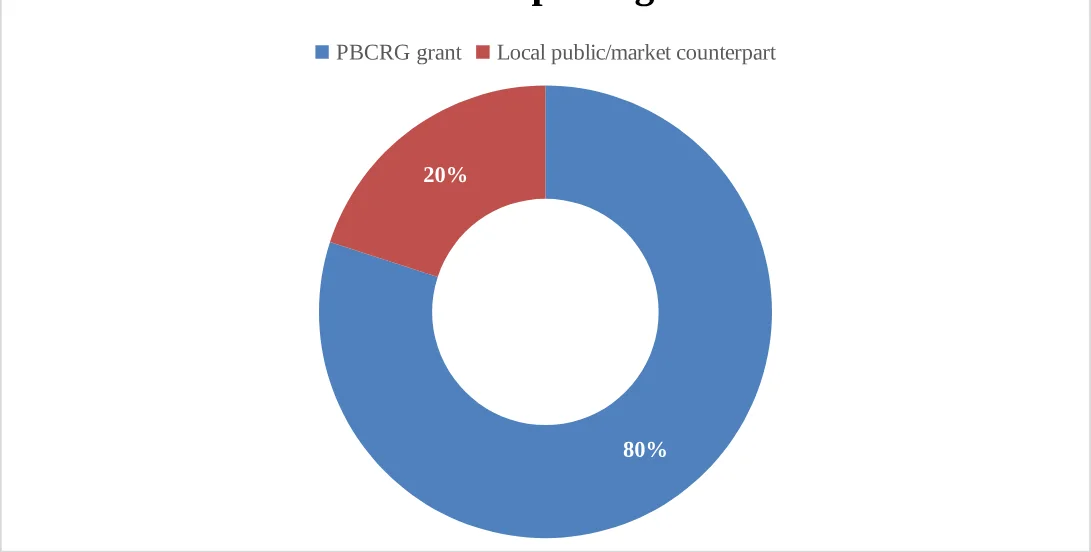
The Shuhashini sales-centre package: BDT 6.8 million from the performance-based grant and BDT 1.7 million from the combined counterpart of the Union parishad and local market-committee. The other half is the counterpart which is 20% of the BDT 8.5 million package. This 20% is not private-capital share as there is no separation between the local-authority and market-committee components.
The geographic scope of the scheme and distribution.
5.2 Geographic Reach and Scheme Distribution
This dimension shows variation between programme reach and local-government schemes between similar districts, as the same total overall does not reflect significant local differences. Table 3 shows the difference between beneficiaries' rank and schemes' rank.
Table 3. Divergence between district beneficiary rank and PBCRG scheme rank.
| District | Beneficiary rank | Scheme rank | Absolute rank gap |
|---|---|---|---|
| Kurigram | 5 | 3 | 2 |
| Sunamganj | 3 | 2 | 1 |
| Khulna | 1 | 5 | 4 |
| Bagerhat | 2 | 6 | 4 |
| Barguna | 4 | 1 | 3 |
| Patuakhali | 6 | 7 | 1 |
| Bhola | 7 | 4 | 3 |
Ranks are descending: rank 1 denotes the highest beneficiary or scheme count. Absolute rank gap is a study calculation.
However, Khulna has the largest absolute rank gap of four, from having the highest Community Resilience Fund reach (7,052 beneficiaries) and 5th fewest schemes, and Bagerhat has the second highest Community Resilience Fund reach (7,017 beneficiaries), and 6th fewest schemes. Barguna has the fourth rank in beneficiaries and first rank in schemes.
The CRF totals of beneficiaries in the seven full district pairs is compared in Figure 3. The chart is provided to give some idea of programme reach prior to the scheme intensity being normalized in the next subsection.
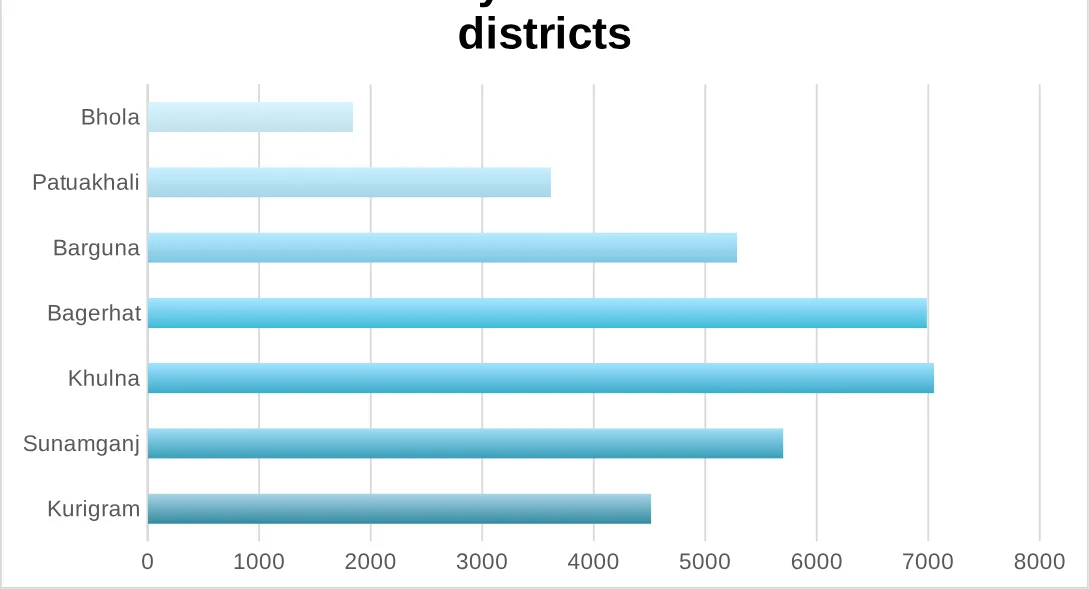
When it comes to the number of beneficiaries, the largest district has a vast number of beneficiaries compared to the smallest, as seen in Figure 3, and the largest district has almost 4 times the number of beneficiaries as the smallest district which has 1,841 beneficiaries. The ordering of schemes is another way and collective investment was not simply cascaded on top of household beneficiary volume. The rank divergence represents an allocation diagnostic – which does not presume that the goal of the grant is to follow the rule of beneficiary proportionality.
5.3 Allocation Intensity and Beneficiary–Scheme Relationship
This dimension examines if there is a correlation between the number of house-hold beneficiaries and number of collective schemes that a district receives. Figure 4 presents data on schemes per 1,000 beneficiaries indicating the number of schemes per beneficiary, so as to eliminate the scale effect which may be caused by the number of beneficiaries per district.
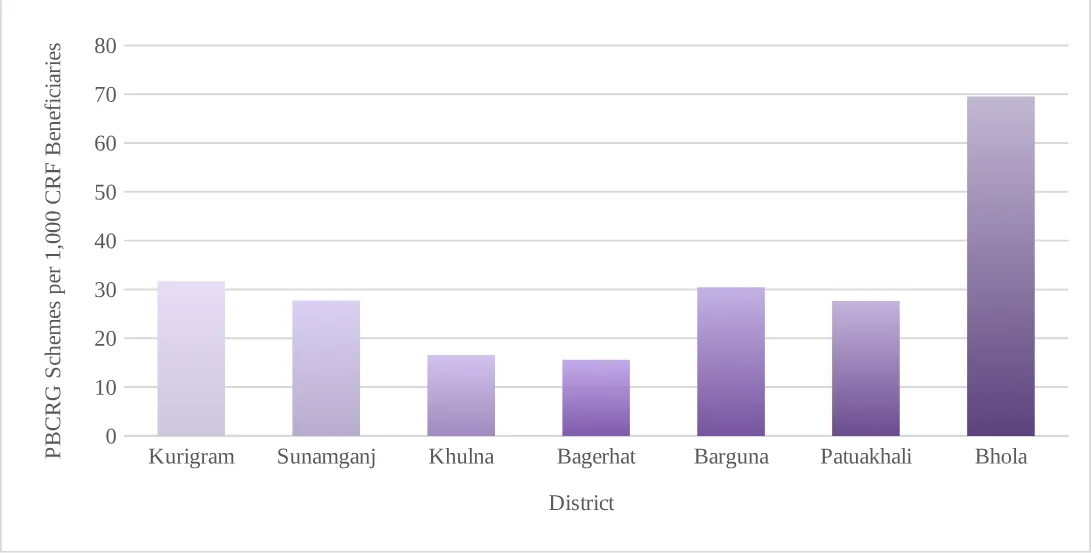
Bhola gets the highest intensity of 69.53 schemes per thousand beneficiaries, Bagerhat the lowest at 15.60 and Khulna at 16.59 is also low.
Figure 5 then compares the number of beneficiaries against the number of PBCRG schemes in a district to see if there is a correlation between the number of households in PBCRG schemes and the number of collective schemes in a district. This chart speaks directly to the allocation relationship, as opposed to normalized intensity.
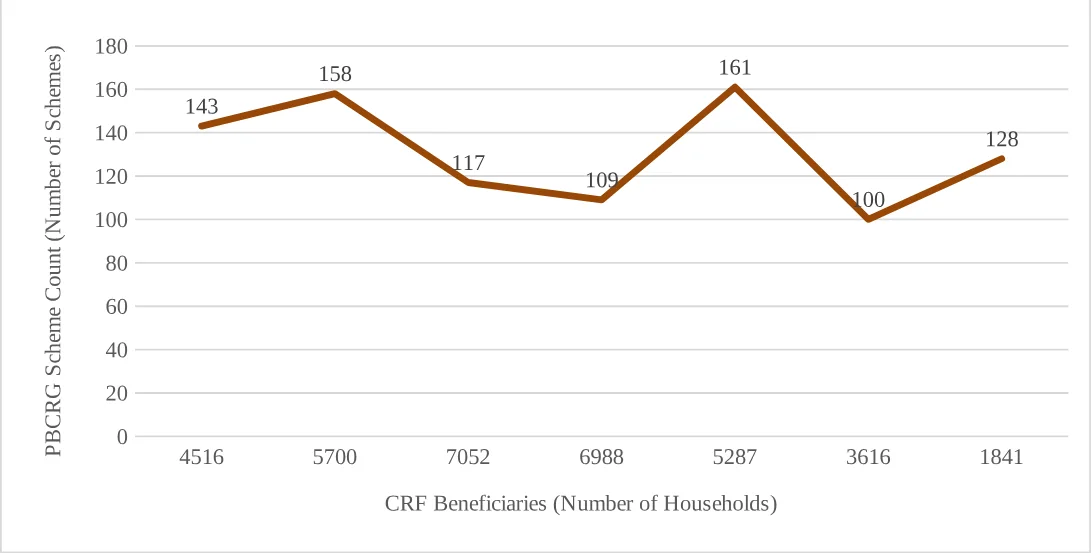
Pearson correlation is 0.006 with p = 0.990, and Spearman correlation is 0.000 with p = 1.000. The almost zero association indicates that the deployment of the scheme is practically not dependent on beneficiary volume in the seven districts portfolio. This trend is consistent with an allocation based on vulnerability and performance, but the seven districts sample does not allow for causal inferences.
5.4 Livelihood and Financial-Inclusion Outcomes
This dimension looks at how household-focused finance relates to reported economic adaptation and access to finance, as resilience also needs income-generating capacity and economic adaptation. The following livelihood response categories are taken from the 1,011-beneficiary assessment and are presented in Table 4.
Table 4. Selected livelihood earnings-response indicators in the CALO assessment
| Livelihood option | Dominant reported response | Share (%) | Analytical reading |
|---|---|---|---|
| Native poultry | Higher earnings | 63.3 | Strongest positive earnings response among selected activities |
| Maize cultivation | Higher earnings | 60.8 | Second strongest positive earnings response |
| Sunflower | No meaningful earnings shift | 84.0 | Dominant limited-change response |
| Watermelon | No meaningful earnings shift | 48.0 | Mixed performance with limited-change category largest |
Source: CALO cross-sectional assessment of 1,011 CRF beneficiaries. Response categories are retained as reported and are not treated as identical statistical tests across activities.
Native poultry has the highest positive earnings response (63.3%) followed by maize cultivation (60.8%). 84.0% of those who reported they had no meaningful shifts in the amount of sunflower they consumed, compared to 48.0% of watermelon participants. The variation suggests that livelihood opportunities vary significantly in terms of the economic response that has been achieved and that livelihood activity choice is as important as enabling access. In total, 42,500 Community Resilience Fund beneficiaries were connected to formal bank accounts and 99% of beneficiaries were female. While this financial-inclusion architecture widens the access to transactions, it is evident that this does not guarantee a uniform livelihood impact across activities.
5.5 Food-Security Resilience Across Agro-Ecologies
This dimension compares the prevalence of food insecurity between hazard ecologies, where the prevalence of food insecurity outcomes may vary in relation to the constraints imposed by the salinity, tidal flooding, riverine dynamics, and wetland conditions. The figure 6 presents the shares of food secure populations in four agro-ecological zones.
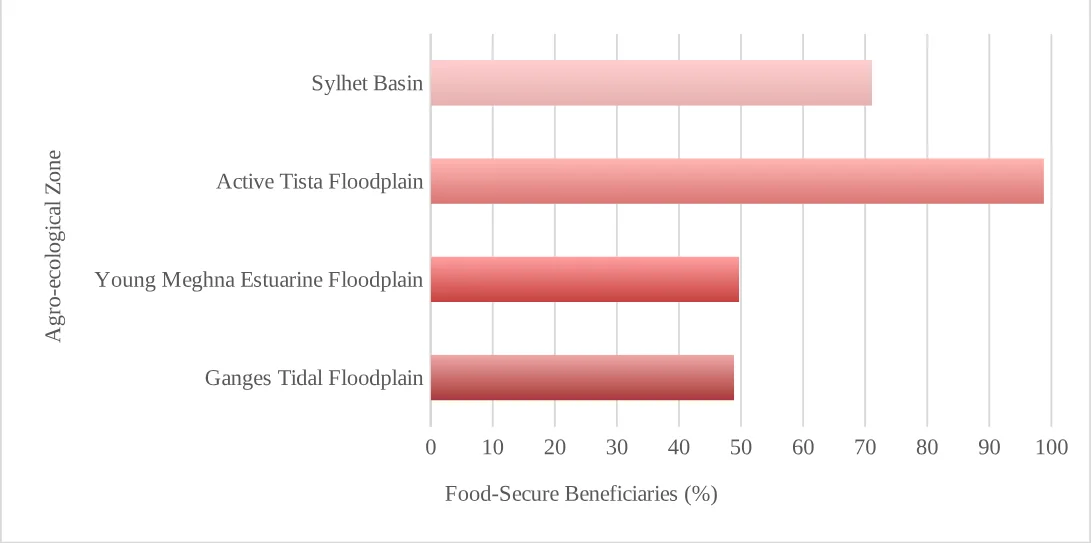
The highest food-security prevalence is observed in the Active Tista Floodplain (98.8%) followed by Sylhet Basin (71.1%). The Young Meghna Estuarine Floodplain has 49.7% and the Ganges Tidal Floodplain the lowest 48.9%. The spread in the zones of highest and lowest percentages (49.9%) is quite large compared to changes in hazard ecology and livelihood context variance in programme finance metrics. Food security is the poorest along coastlines and estuaries, even when people are part of the same general food security adaptation programme.
5.6 Adaptive Confidence and Practice Change
This dimension measures the extent of perception of adaptation capacity and behavioral adjustment as resilience requires confidence in the ability to adapt to the climatic stress and observable behavioral change in livelihood practices. Figure 7 shows that the percentages of those who indicated confidence in adaptive capacity and those who indicated they were taking on a few new types of crop or animal are similar.
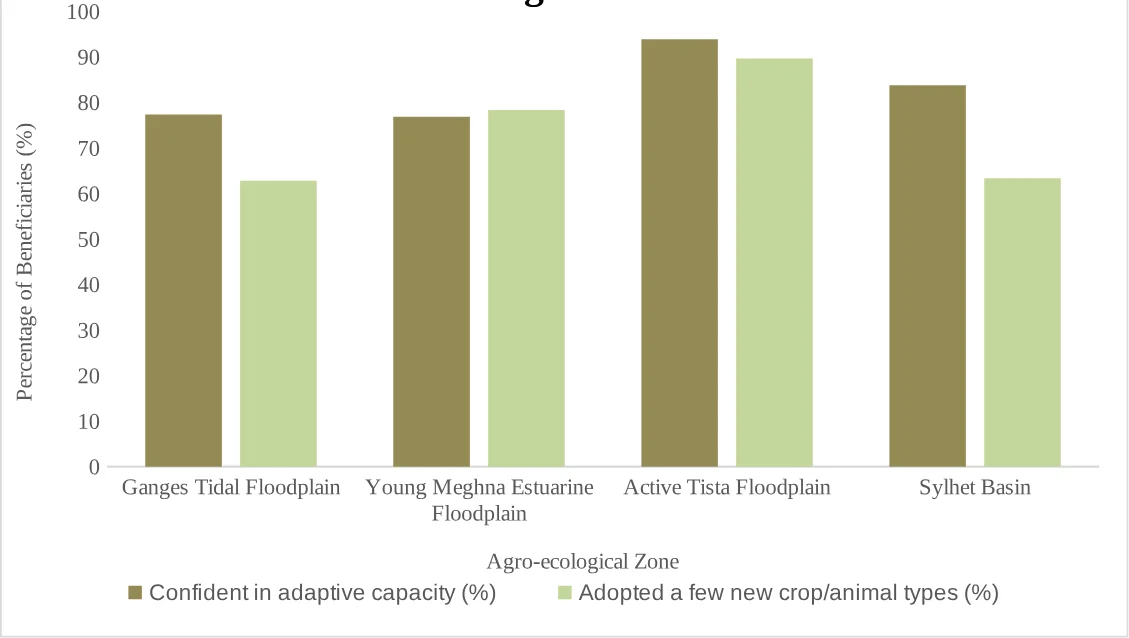
The Active Tista Floodplain leads both measures with 93.9% reporting high levels of confidence and 89.7% reporting levels of practice adoption. Adaptive confidence is lowest in the Young Meghna Estuarine Floodplain (76.9%) while that of the Ganges Tidal Floodplain is lowest (62.8%). Sylhet has relatively high levels of confidence (83.8%) and relatively low levels of practice adoption (63.4%) which is reflected in the largest within-zone difference between the two elements. The difference between these two indicates that there is a relationship between perceived capability and realized livelihood change, but that there are constraints on implementation to be seen even if confidence is relatively high.
5.7 Governance Observability and Private-Capital Traceability
This dimension judges whether published programme information is capable of distinguishing between public, local, community and private contributions as there is a need for traceability of the contributions and actions of those involved with public–private finance claims. Table 5 displays an audit of the reporting-observability.
Table 5. Governance observability and contributor-traceability audit
| Published indicator | Observable? | Contributor-level separation? | Interpretive status |
|---|---|---|---|
| CRF and PBCRG channel totals | Yes | Grant channels separated | Suitable for channel composition and intensity |
| District CRF beneficiaries and PBCRG schemes | Yes | District and channel separated | Suitable for geographic allocation analysis |
| Portfolio co-financing incidence | Yes: 68% of schemes | No actor-level monetary split | Suitable for incidence, not private leverage ratio |
| Case-level counterpart value | Yes for documented package | Union Parishad + market committee combined | Suitable as blended counterpart illustration |
| Portfolio-wide private-capital amount | No | No | Not quantifiable from published output data |
The audit distinguishes data availability from financial attribution; a reported counterpart contribution is not classified as private capital without actor-level separation.
Large amounts of money, district schemes, numbers of beneficiaries and overall co-financing incidence can be discerned. There is no disaggregation of the amounts of co-financing by contributor type and no portfolio-wide private-capital total is reported. Case level reporting shows that there are blended counterparts to the resources but the categories of the contributors are not separated in the documented local package. The principal governance issue is the lack of actor-separated financial reporting to more carefully and precisely measure private leverage, compare leverage across locations and separate local public assets from commercial investment or from household contributions.
6. Discussion
The findings suggest that local adaptation finance in Bangladesh works best when local and collective financing mechanisms go hand-in-hand. Household liquidity and livelihood assets, and formal financial services are covered by the Community Resilience Fund, and shared infrastructure and community schemes are funded by performance-based local-government grants. It is a dual structure that addresses the financing issue raised in earlier household studies which found that adaptation recipients are still using their informal sources of finance, such as savings and borrowing, in addition to formal finance [5]. It also prevents an infrastructure-only approach, where the capacity of households is not linked to collective resilience assets. It is more important to note the institutional complementarity among the two channels that is evident in the observed 57.3:42.7 funding split. The impact of household grants is on the potential to act; the impact of local-government grants is on the physical and institutional conditions in which that action takes place.
The second key finding is that there is very little correlation between district beneficiary and scheme counts. Initially, the use of non-proportional allocation might seem to be inconsistent. In a system of grants based on vulnerability and performance, however, the proportionality to the number of beneficiaries is not the key objective. The allocation and implementation are the result of interactions between the national organizations, local institutions, planning processes and power relations, as revealed by multi-level governance research in Bangladesh [7]. The district pattern can be used in an allocation logic that takes into account hazard exposure, local performance, area, revenue capacity, and project characteristics. The result also highlights the importance of transparent reporting of the components of a formula as the incentive to allocate by performance has been weakened if local actors can't explain how they have calculated the intensity of a scheme for like districts. When the allocation calculation is made public, then auditability and local trust would be further enhanced.
The finance totals alone do not show the same level of contextual gradient as do the resilience outcomes. Almost all the Active Tista Floodplain is food secure while less than half is food secure in Ganges Tidal and Young Meghna Estuarine floodplains. The general advantage is similar for adaptive confidence and practice adoption in the Tista zone, with a few instances where confidence outranks practice adoption. This research on adaptive governance is explained by the concepts of institutional fit, learning and implementation conditions: knowledge or confidence do not necessarily translate to action when markets, infrastructure, authority, or resources are limiting [9]. The research on coastal governance also highlights the lack of voice, accountability and institutional performance as impediments to formal climate action turning into lasting resilience [14]. The outcomes then challenge the idea of a common national understanding of adaptation performance and hazard ecology is materially shaping the return from similar financing mechanisms.
What is added by the co-financing findings is a clarification of the public–private funding argument. The incidence of 68% shows that local schemes often attract extra resources or funding other than the main grant, but the amount, risks and who provides the resources is not captured in the incidence. Private-adaptation-finance research distinguishes the direct private investment done from the general private involvement in markets, services and implementation [11]. The case reported in the document for a sales center is an example of this: the counterpart value is reported jointly by local-government and market-committee areas, and no total using private capital can be derived. For evaluation of a policy, leverage ratios should be implemented on the basis of the monetary reporting on the contributor level, not on the basis of a binary co-financing flag. If it were not for that separation, it would seem that seemingly high leverage could end up being a catchall for public land, community effort, market assets and commercial capital and be devoid of analytical precision.
The results converge on a finance to resilience perspective where money flows into a governance system as opposed to a linear project pipeline. Fiscal design influences local incentives, local institutions influence selection and implementation, hazard ecology influences returns and household learning influences uptake. These are tied together by authority, coordination and accountability in a multi-level governance perspective [7]. The study builds on this idea by linking governance mechanisms to quantifiable financing channels and diverse resilience outcomes. Another methodological implication has to do with denominator discipline – programme scale finance, district allocation and beneficiary outcomes refer to different populations and must be carefully triangulated. When they are used together, out of scope would result in misleading ratios of performance. The integrated approach thus provides a replicable setting for assessing locally-led adaptation programmes while also maintaining separation between the financial volume, the quality of the financial allocation, the quality of governance, and the quality of the resilience outcomes.
7. Conclusion
Financing mechanisms that link household adaptation, provide collective risk-reduction infrastructure and facilitate accountable local governance are needed in climate-sensitive areas of Bangladesh. This study explored that relationship in the context of a secondary data comparative design that combined information from a verified programme finance with seven-district intervention records with resilience outcomes from a livelihood assessment involving 1011 beneficiaries. The financing architecture includes USD 12.26 million in grants for household resilience, USD 9.14 million in grants to local governments based on performance, and 68% of collective schemes report co-financing. The distribution of the allocation of district schemes is almost independent of beneficiaries' volume, pointing towards a non-proportional distribution of the scheme consistent with a vulnerability and performance-based logic of grant distribution.
The outcomes of resilience are still very varied with food security and adaptive indicators being strongest in the Active Tista Floodplain and weaker in the coastal tidal and estuarine ecosystems. The primary contribution of the main document is an integrated approach to finance-to-resilience framework, which de-couples funding volume, allocation, co-financing, governance, and outcomes, as opposed to funding as a standalone performance measure. Another significant transparency gap is the lack of private-sector co-financing data at portfolio scale, as these data are published separately from data relating to local-government, market-committee, and community counterpart funds. Limitations are that the allocation sample is only for the seven districts, the denominators of the secondary data are not compatible across programme components, and there is limited financial disclosure at the actor level.
There is a need for future research to have linked longitudinal financial and household outcome data for households, contributor-level capital tags, better measures of maintenance, and quasi-experimental evaluation of the allocation of grants and maintenance effects.
8. Recommendations
Based on the findings, there are six actions. First, a ledger of contributors is needed to separate out the costs covered by public money from the central government, development-partner funds, money from local governments, community money or in-kind inputs, money from the market-committee, and private investment. Secondly, it is important that the Performance-based formulas be disclosed at the local government level, including the components of vulnerability, fiscal-capacity, performance, and project-selection. Third, a shift in the livelihood portfolios towards more performing livelihoods should be realised over time, and better market access, extension and periodic visits to the low performing livelihoods. Fourth, investments should be focused on coastal tidal and estuarine localities to boost food-security and livelihood-resilience as there is still a considerable gap in achieving outcomes even though they are part of the programmes. Fifth, co-financing design must also make sure that the adaptation costs are not shifted to the vulnerable households through the mechanism of debt or the need for a counterpart contribution. Sixth, there is a need to have one local monitoring platform that integrates finance, scheme delivery, maintenance, livelihood outcomes, gender inclusion, hazard context and contributor type to create greater accountability, support adaptive planning, and enable repeat and comparable local monitoring of the local resilience as the funding journey progresses.
Author Contributions
Author Contributions: Conceptualization, methodology, data curation, formal analysis, visualization, writing—original draft, and writing—review and editing: author(s). Final CRediT roles require confirmation by the submitting author team before journal submission.
Conflict of Interest
Conflict of Interest: No conflict statement is asserted on behalf of unidentified authors. The submitting author team must confirm and replace this statement with the journal-required declaration before submission.
References
- [1] L. Berrang-Ford et al., "A systematic global stocktake of evidence on human adaptation to climate change," Nature Climate Change, vol. 11, pp. 989–1000, 2021. DOI: https://doi.org/10.1038/s41558-021-01170-y; Publisher: https://www.nature.com/articles/s41558-021-01170-y
- [2] G. M. Alam, K. Alam, and S. Mushtaq, "Climate change perceptions and local adaptation strategies of hazard-prone rural households in Bangladesh," Climate Risk Management, vol. 17, pp. 52–63, 2017. DOI: https://doi.org/10.1016/j.crm.2017.06.006; Publisher: https://www.sciencedirect.com/science/article/pii/S221209631730013X
- [3] M. R. Karim and A. Thiel, "Role of community based local institution for climate change adaptation in the Teesta riverine area of Bangladesh," Climate Risk Management, vol. 17, pp. 92–103, 2017. DOI: https://doi.org/10.1016/j.crm.2017.06.002; Publisher: https://www.sciencedirect.com/science/article/pii/S2212096317300177
- [4] M.-U.-I. Choudhury, M. S. Uddin, and C. E. Haque, "“Nature brings us extreme events, some people cause us prolonged sufferings”: the role of good governance in building community resilience to natural disasters in Bangladesh," Journal of Environmental Planning and Management, vol. 62(10), pp. 1761–1781, 2019. DOI: https://doi.org/10.1080/09640568.2018.1513833; Publisher: https://www.tandfonline.com/doi/full/10.1080/09640568.2018.1513833
- [5] F. A. Hussain and M. M. Ahmad, "Effect of climate finance on adaptation in the southwestern coastal region of Bangladesh," Development in Practice, vol. 30(7), pp. 905–922, 2020. DOI: https://doi.org/10.1080/09614524.2020.1779663; Publisher: https://www.tandfonline.com/doi/full/10.1080/09614524.2020.1779663
- [6] M. Khan, S.-A. Robinson, R. Weikmans, D. Ciplet, and J. T. Roberts, "Twenty-five years of adaptation finance through a climate justice lens," Climatic Change, vol. 161, pp. 251–269, 2020. DOI: https://doi.org/10.1007/s10584-019-02563-x; Publisher: https://link.springer.com/article/10.1007/s10584-019-02563-x
- [7] A. Ishtiaque, H. Eakin, S. Vij, N. Chhetri, F. Rahman, and S. Huq, "Multilevel governance in climate change adaptation in Bangladesh: structure, processes, and power dynamics," Regional Environmental Change, vol. 21(3), pp. Article 75, 2021. DOI: https://doi.org/10.1007/s10113-021-01802-1; Publisher: https://link.springer.com/article/10.1007/s10113-021-01802-1
- [8] M. Mohibbullah, A. K. Gain, and M. N. Ahsan, "Examining local institutional networks for sustainable disaster management: Empirical evidence from the South-West coastal areas in Bangladesh," Environmental Science & Policy, vol. 124, pp. 433–440, 2021. DOI: https://doi.org/10.1016/j.envsci.2021.07.016; Publisher: https://www.sciencedirect.com/science/article/abs/pii/S146290112100201X
- [9] M.-U.-I. Choudhury, C. E. Haque, and B. Doberstein, "Adaptive governance and community resilience to cyclones in coastal Bangladesh: Addressing the problem of fit, social learning, and institutional collaboration," Environmental Science & Policy, vol. 124, pp. 580–592, 2021. DOI: https://doi.org/10.1016/j.envsci.2021.08.007; Publisher: https://www.sciencedirect.com/science/article/abs/pii/S1462901121002203
- [10] M. S. Uddin, C. E. Haque, M. N. Khan, B. Doberstein, and R. S. Cox, "“Disasters threaten livelihoods, and people cope, adapt and make transformational changes”: Community resilience and livelihoods reconstruction in coastal communities of Bangladesh," International Journal of Disaster Risk Reduction, vol. 63, pp. 102444, 2021. DOI: https://doi.org/10.1016/j.ijdrr.2021.102444; Publisher: https://www.sciencedirect.com/science/article/abs/pii/S2212420921004052
- [11] P. P. Stoll, W. P. Pauw, F. Tohme, and C. Grüning, "Mobilizing private adaptation finance: lessons learned from the Green Climate Fund," Climatic Change, vol. 167, pp. Article 45, 2021. DOI: https://doi.org/10.1007/s10584-021-03190-1; Publisher: https://link.springer.com/article/10.1007/s10584-021-03190-1
- [12] M. N. I. Sarker, Y. Peng, M. N. Khatun, G. M. M. Alam, R. C. Shouse, and M. R. Amin, "Climate finance governance in hazard prone riverine islands in Bangladesh: pathway for promoting climate resilience," Natural Hazards, vol. 110(2), pp. 1115–1132, 2022. DOI: https://doi.org/10.1007/s11069-021-04983-4; Publisher: https://link.springer.com/article/10.1007/s11069-021-04983-4
- [13] M. A. Hossen, C. Netherton, D. Benson, M. R. Rahman, and M. Salehin, "A governance perspective for climate change adaptation: Conceptualizing the policy-community interface in Bangladesh," Environmental Science & Policy, vol. 137, pp. 174–184, 2022. DOI: https://doi.org/10.1016/j.envsci.2022.08.028; Publisher: https://www.sciencedirect.com/science/article/pii/S1462901122002787
- [14] M. M. Rahman, "Governance constraints in building climate resilience: Evidence from coastal Bangladesh," GeoJournal, vol. 88, pp. 6189–6206, 2023. DOI: https://doi.org/10.1007/s10708-023-10964-w; Publisher: https://link.springer.com/article/10.1007/s10708-023-10964-w
- [15] G. Morshed, C. Tortajada, and M. S. Hossain, "The state of climate change adaptation research in Bangladesh: a systematic literature review," Mitigation and Adaptation Strategies for Global Change, vol. 30, pp. Article 31, 2025. DOI: https://doi.org/10.1007/s11027-025-10219-8; Publisher: https://link.springer.com/article/10.1007/s11027-025-10219-8
- [16] F. Crick, K. E. Gannon, M. Diop, and M. Sow, "Enabling private sector adaptation to climate change in sub-Saharan Africa," WIREs Climate Change, vol. 9(2), pp. e505, 2018. DOI: https://doi.org/10.1002/wcc.505; Publisher: https://wires.onlinelibrary.wiley.com/doi/10.1002/wcc.505
- [17] M. N. I. Sarker, J. Wen, B. Yang, S. Yusufzada, N. Huda, and F. Mahbub, "Assessment of environmental governance in disaster vulnerability context of rural Bangladesh," Growth and Change, vol. 52(2), pp. 1155–1171, 2021. DOI: https://doi.org/10.1111/grow.12482; Publisher: https://onlinelibrary.wiley.com/doi/10.1111/grow.12482
- [18] M.-U.-I. Choudhury, C. E. Haque, and G. Hostetler, "Transformative learning and community resilience to cyclones and storm surges: The case of coastal communities in Bangladesh," International Journal of Disaster Risk Reduction, vol. 55, pp. 102063, 2021. DOI: https://doi.org/10.1016/j.ijdrr.2021.102063; Publisher: https://www.sciencedirect.com/science/article/pii/S2212420921000297
- [19] M.-U.-I. Choudhury, C. E. Haque, A. Nishat, and S. Byrne, "Social learning for building community resilience to cyclones: role of indigenous and local knowledge, power, and institutions in coastal Bangladesh," Ecology and Society, vol. 26(1), pp. Article 5, 2021. DOI: https://doi.org/10.5751/ES-12107-260105; Publisher: https://www.ecologyandsociety.org/vol26/iss1/art5/
- [20] M. Masud-All-Kamal and M. Nursey-Bray, "Socially just community-based climate change adaptation? Insights from Bangladesh," Local Environment, vol. 26(9), pp. 1092–1108, 2021. DOI: https://doi.org/10.1080/13549839.2021.1962829; Publisher: https://www.tandfonline.com/doi/abs/10.1080/13549839.2021.1962829
- [21] M. Jänicke, "The Multi-level System of Global Climate Governance – the Model and its Current State," Environmental Policy and Governance, vol. 27(2), pp. 108–121, 2017. DOI: https://doi.org/10.1002/eet.1747; Publisher: https://onlinelibrary.wiley.com/doi/abs/10.1002/eet.1747
CITE THIS ARTICLE
Afrin, S. (2026). Financing Local Climate Adaptation and Disaster Risk Reduction: Public–Private Funding, Multi-Level Governance, and Community Resilience in Climate-Vulnerable Regions in Bangladesh. https://www.researchbysadia.com/article/f6b4a1f0-90f5-4b42-a03e-38fe5bd1f66d
S. Afrin, “Financing Local Climate Adaptation and Disaster Risk Reduction: Public–Private Funding, Multi-Level Governance, and Community Resilience in Climate-Vulnerable Regions in Bangladesh,” 2026. [Online]. Available: https://www.researchbysadia.com/article/f6b4a1f0-90f5-4b42-a03e-38fe5bd1f66d
Afrin, S. (2026) ‘Financing Local Climate Adaptation and Disaster Risk Reduction: Public–Private Funding, Multi-Level Governance, and Community Resilience in Climate-Vulnerable Regions in Bangladesh’. Available at: https://www.researchbysadia.com/article/f6b4a1f0-90f5-4b42-a03e-38fe5bd1f66d
Afrin, Sadia. “Financing Local Climate Adaptation and Disaster Risk Reduction: Public–Private Funding, Multi-Level Governance, and Community Resilience in Climate-Vulnerable Regions in Bangladesh.” 2026, https://www.researchbysadia.com/article/f6b4a1f0-90f5-4b42-a03e-38fe5bd1f66d.
Sadia Afrin. “Financing Local Climate Adaptation and Disaster Risk Reduction: Public–Private Funding, Multi-Level Governance, and Community Resilience in Climate-Vulnerable Regions in Bangladesh.” (2026). https://www.researchbysadia.com/article/f6b4a1f0-90f5-4b42-a03e-38fe5bd1f66d.
Afrin S. Financing Local Climate Adaptation and Disaster Risk Reduction: Public–Private Funding, Multi-Level Governance, and Community Resilience in Climate-Vulnerable Regions in Bangladesh. 2026. https://www.researchbysadia.com/article/f6b4a1f0-90f5-4b42-a03e-38fe5bd1f66d
@misc{article_f6b4a1f090f54b42a03e38fe5bd1f66d,
  title = {Financing Local Climate Adaptation and Disaster Risk Reduction: Public–Private Funding, Multi-Level Governance, and Community Resilience in Climate-Vulnerable Regions in Bangladesh},
  author = {Sadia Afrin},
  year = {2026},
  url = {https://www.researchbysadia.com/article/f6b4a1f0-90f5-4b42-a03e-38fe5bd1f66d},
}
TY - GEN AU - Sadia Afrin TI - Financing Local Climate Adaptation and Disaster Risk Reduction: Public–Private Funding, Multi-Level Governance, and Community Resilience in Climate-Vulnerable Regions in Bangladesh PY - 2026 UR - https://www.researchbysadia.com/article/f6b4a1f0-90f5-4b42-a03e-38fe5bd1f66d ER -